lenatriestounderstand

Labs

Proof you can run

Where a long read argues the ideas, a lab proves them — a runnable, reproducible notebook that takes a claim apart on a real model, with code you can run, change, and break. Executed offline; every number reproduces on a re-render. Browse the long reads →.

Deep Learning · Lab

Training Neural Networks: Backprop, Regularization, and Everything in Between
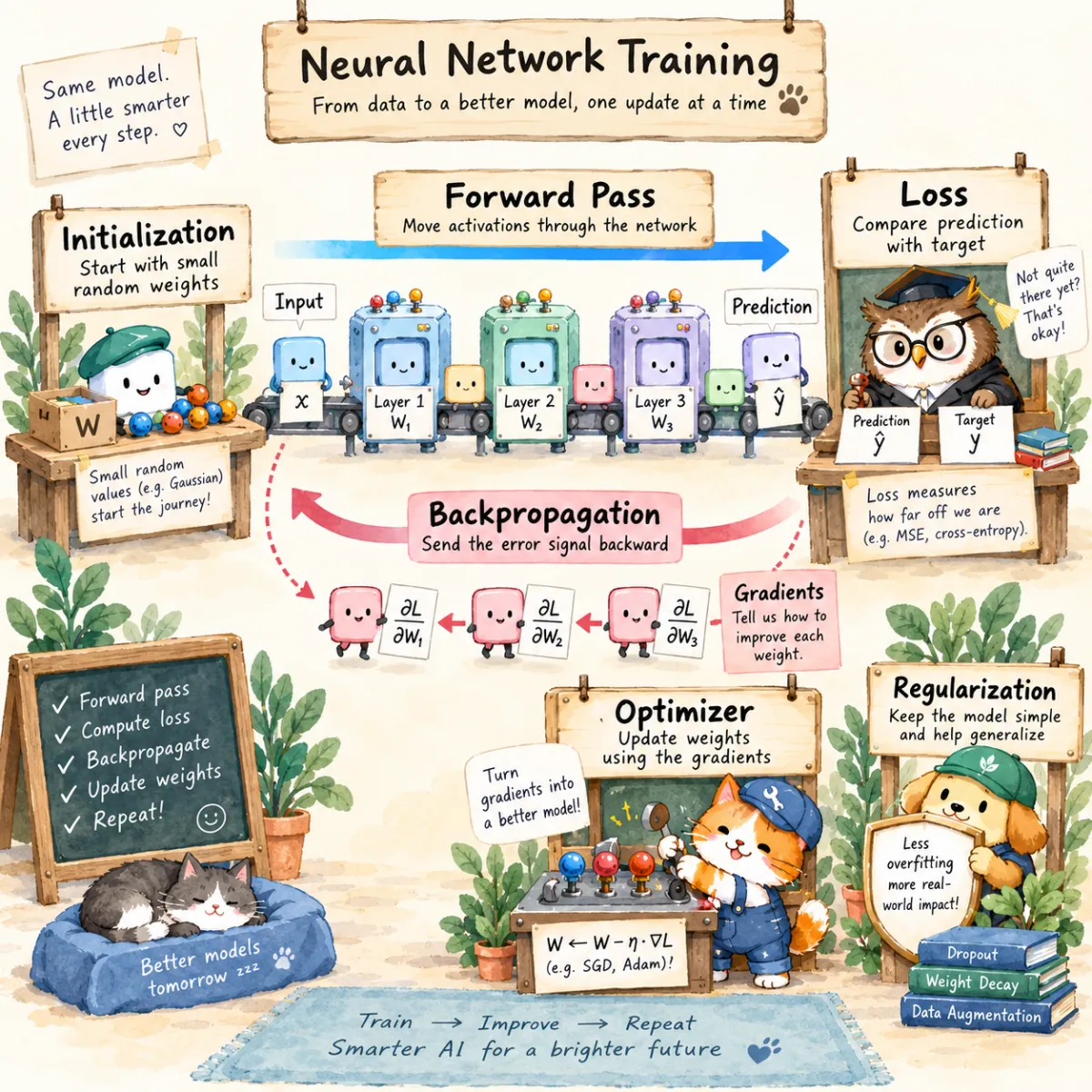
One number at the end of the network has to become an instruction for every number inside it. That trip is the whole of training: backpropagation as the chain rule run backwards through a graph, the product of many numbers that decides whether the instruction survives the journey, the initialization arithmetic that keeps that product near one and the normalization, clipping and precision choices that answer the other half of the problem, and regularization as the deliberate corruption that makes the result generalize — every claim carried by one worked example, from two weights done by hand to a network that overfits.

Read
Sep 12, 2026
ML Systems · Lab

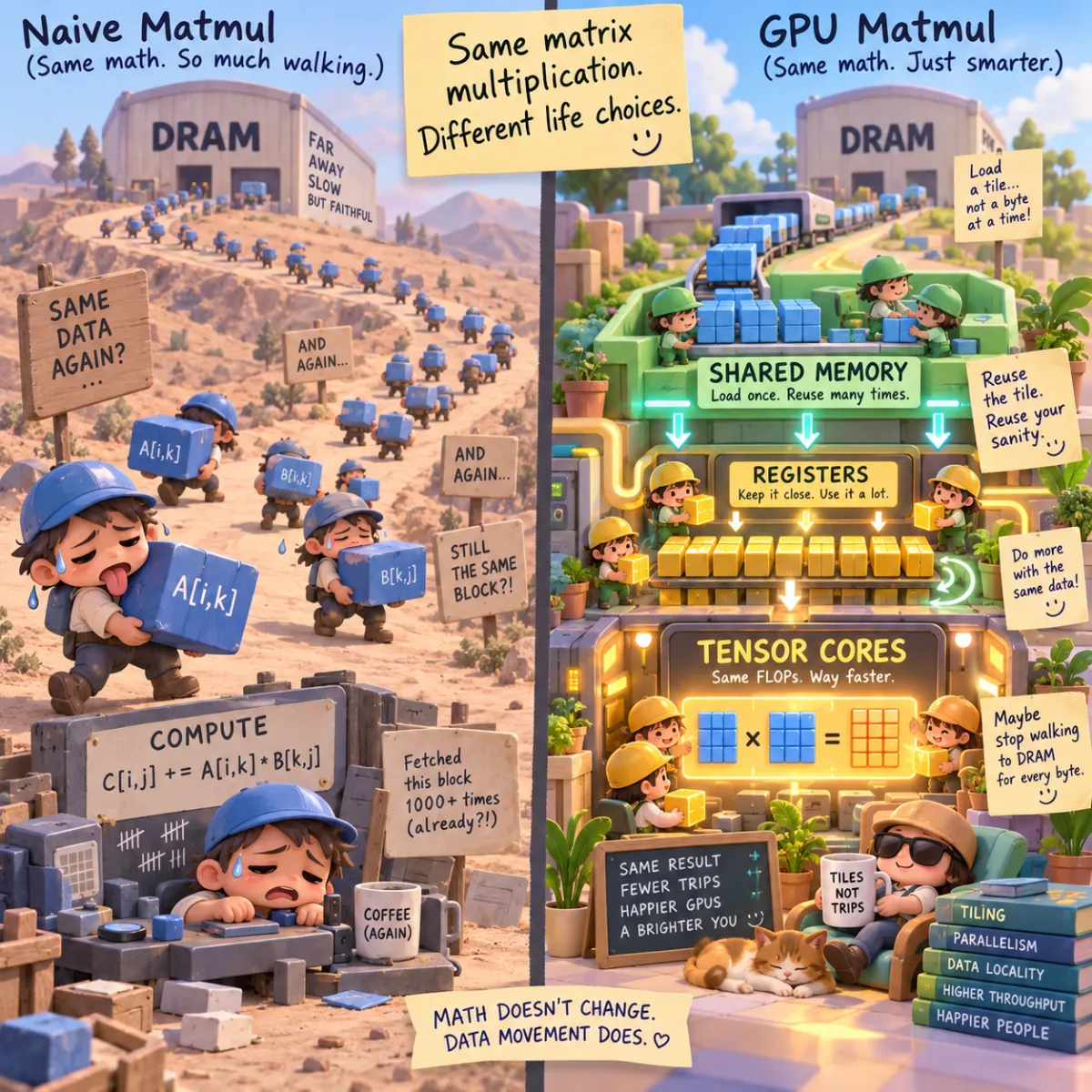
Matrix Multiplication: The Operation Behind Modern AI

Most of the arithmetic in a neural network is matrix multiplication. Written the obvious way it is correct, and fifty times slower than torch.mm on the same GPU. Where that difference comes from, one change at a time on a Tesla T4: coalescing, tiles, shared memory, registers, tensor cores and precision — and why almost all of it is about where the numbers are kept rather than how they are multiplied.

Read
Sep 12, 2026
ML Systems · Lab

How GPUs Actually Run Machine Learning

Why the same GPU is nineteen times faster than the CPU at one operation, eleven times at the next, and slower at a third — worked out on a real Tesla T4, from two numbers per machine: how fast it computes and how fast it moves bytes. Along the way: warps and SIMT, latency hiding, the memory hierarchy, arithmetic intensity, the roofline, and a power limit that moves the ceiling.

Read
Sep 11, 2026
Deep Learning · Lab

Teaching a Neural Network to Play Go

Building a tiny AlphaGo from scratch on a 5×5 board: board representation, a small CNN policy network, a value network, and then Monte Carlo Tree Search — with each piece introduced only when the previous version visibly runs out of road. Ends at a self-play loop that is recognisably AlphaZero in miniature.

Read
Aug 10, 2026
LLM · Lab

Learning Rules from Examples: How Can a Model Discover a Hidden Rule?

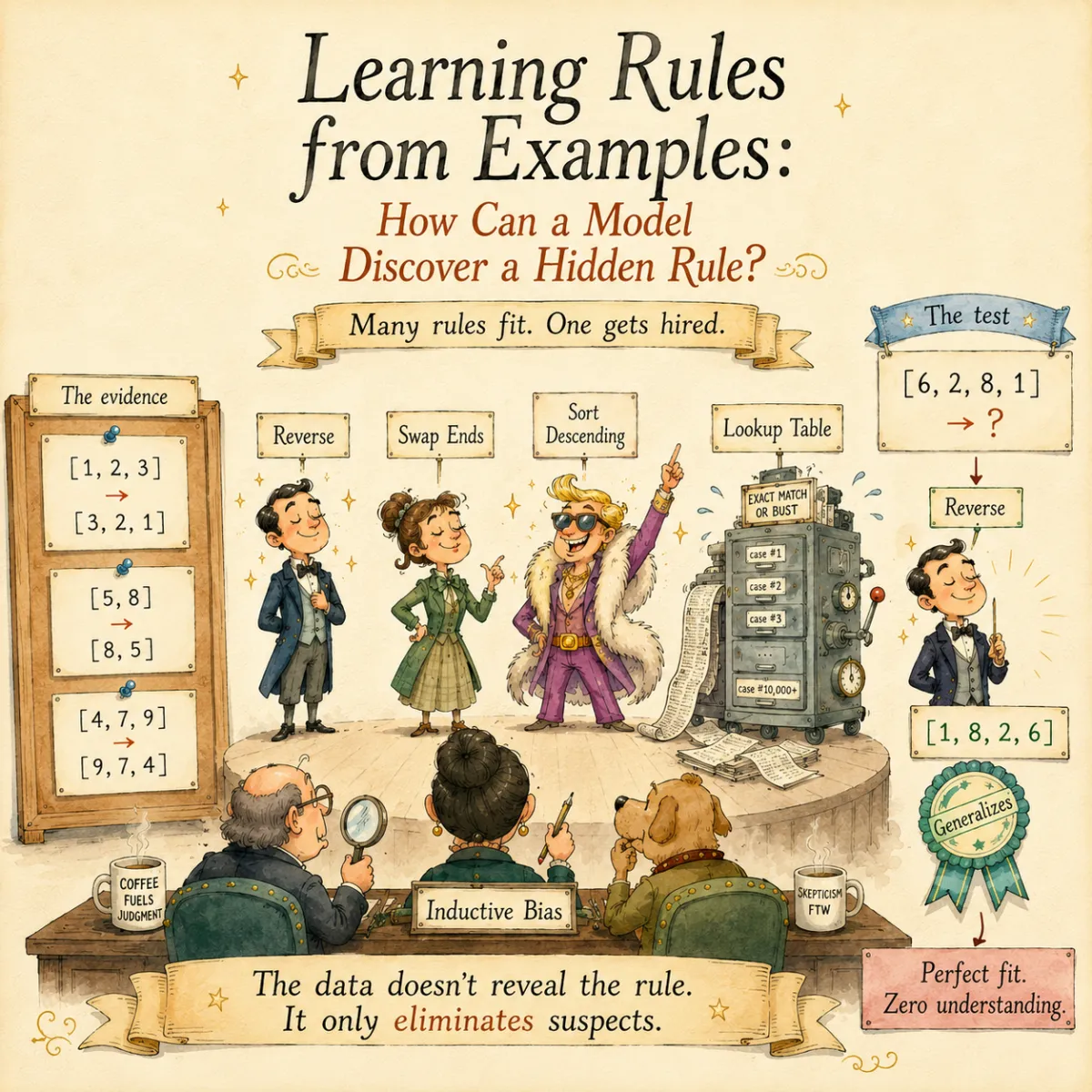
A tiny synthetic world where the rule is hidden and the evidence is controlled. Version spaces and what a dataset actually tells you, why a deterministic likelihood makes generalization entirely a matter of prior, shortcut features, expected information gain and active learning, compositional and length generalization, bottom-up program search with observational-equivalence pruning, LLM-guided synthesis, and libraries that grow their own primitives — each turned into a small experiment with a deterministic verifier.

Read
Aug 9, 2026
Deep Learning · Lab

Neural Network Architectures and PyTorch (MLP, CNN, RNN/LSTM)

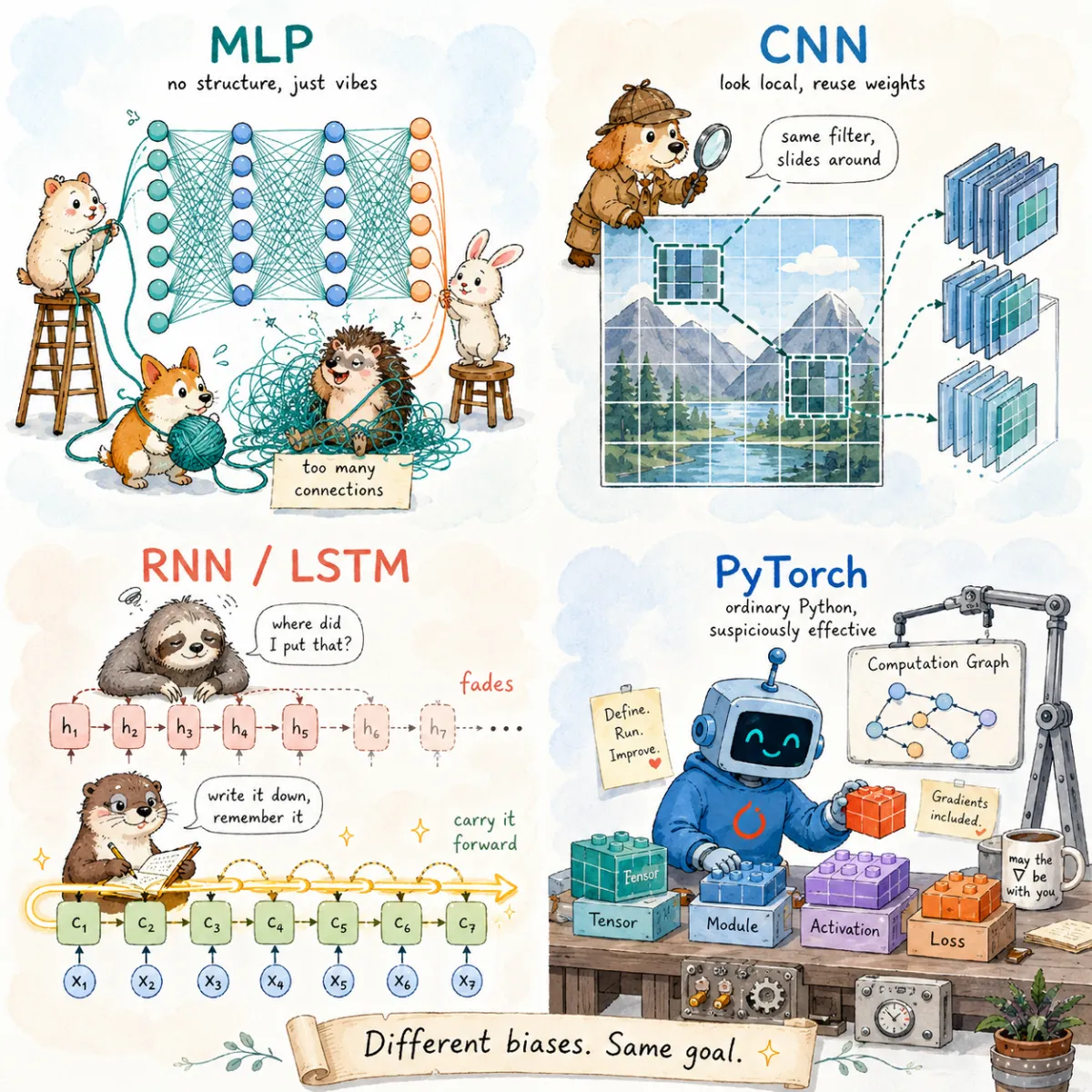
An architecture is a claim about your data, and every claim here is measured: why a stack of linear layers is one straight line, what a CNN's first layer actually learns, how fast a receptive field grows, where an RNN's gradient dies — and PyTorch as three ideas: a tensor, a tape, and a module.

Read
Jul 21, 2026
Deep Learning · Lab

Mechanistic Interpretability: Looking Inside the Black Box

What it actually means to reverse-engineer a neural network into features and circuits: the residual stream as a linear object, the linear representation hypothesis, superposition and why features outnumber neurons, sparse autoencoders as dictionary learning, the QK/OV decomposition of attention, induction heads, and the causal methods — activation and path patching — that turn a plausible story into a verified mechanism.

Read
Jul 4, 2026
Embeddings and Retrieval · Lab

Chunking Strategies

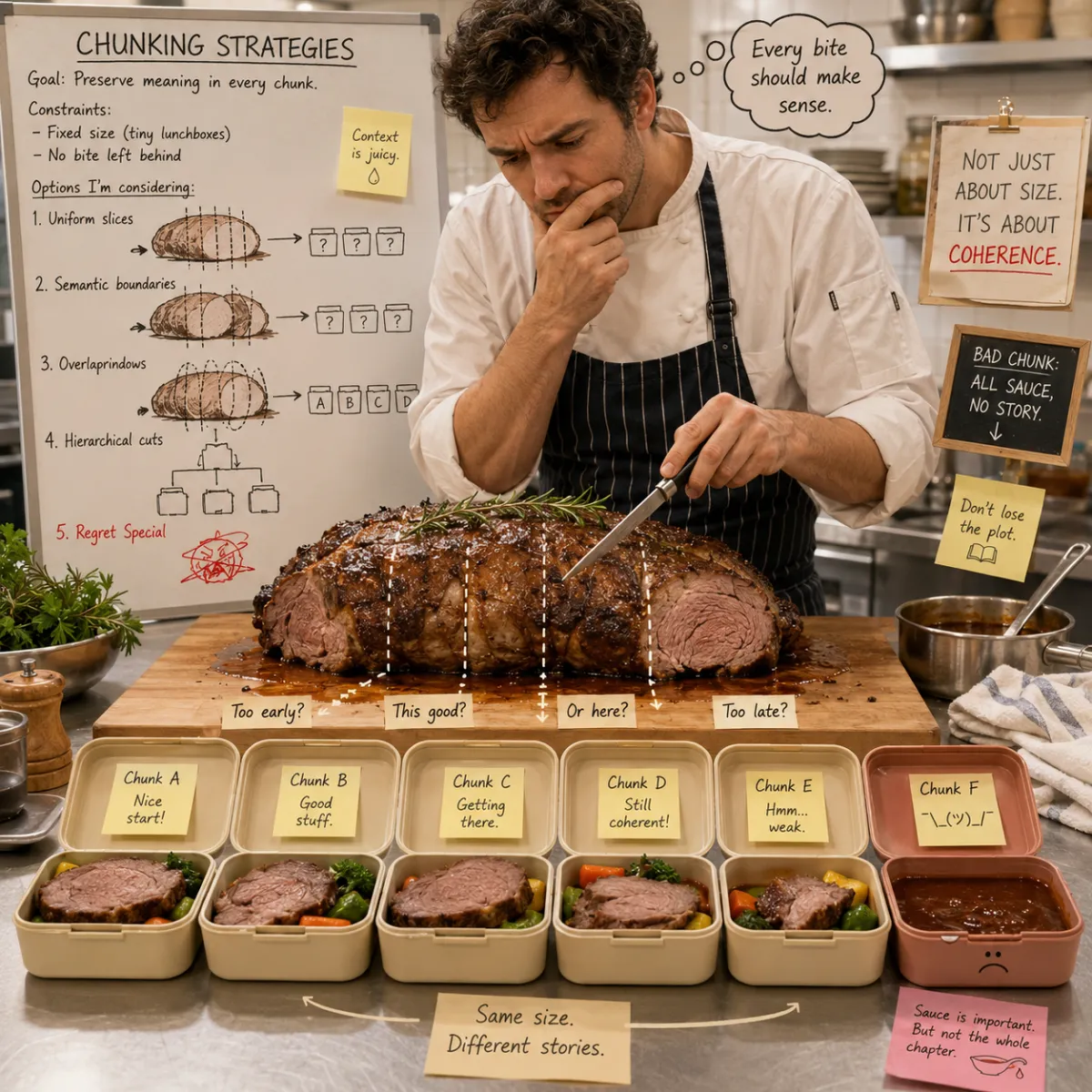
Chunking turns out to be more architectural than it looks. A walk through what a chunk has to satisfy at six different stages simultaneously, what RecursiveCharacterTextSplitter actually does under the hood, and what the 2024–2026 toolbox — late chunking, contextual retrieval, contextualized chunk embeddings, BGE-M3 multi-functionality, ColBERT late interaction — is actually for.

Read
Jul 4, 2026
Classical ML · Lab

Text Clustering: Representation Over Algorithm

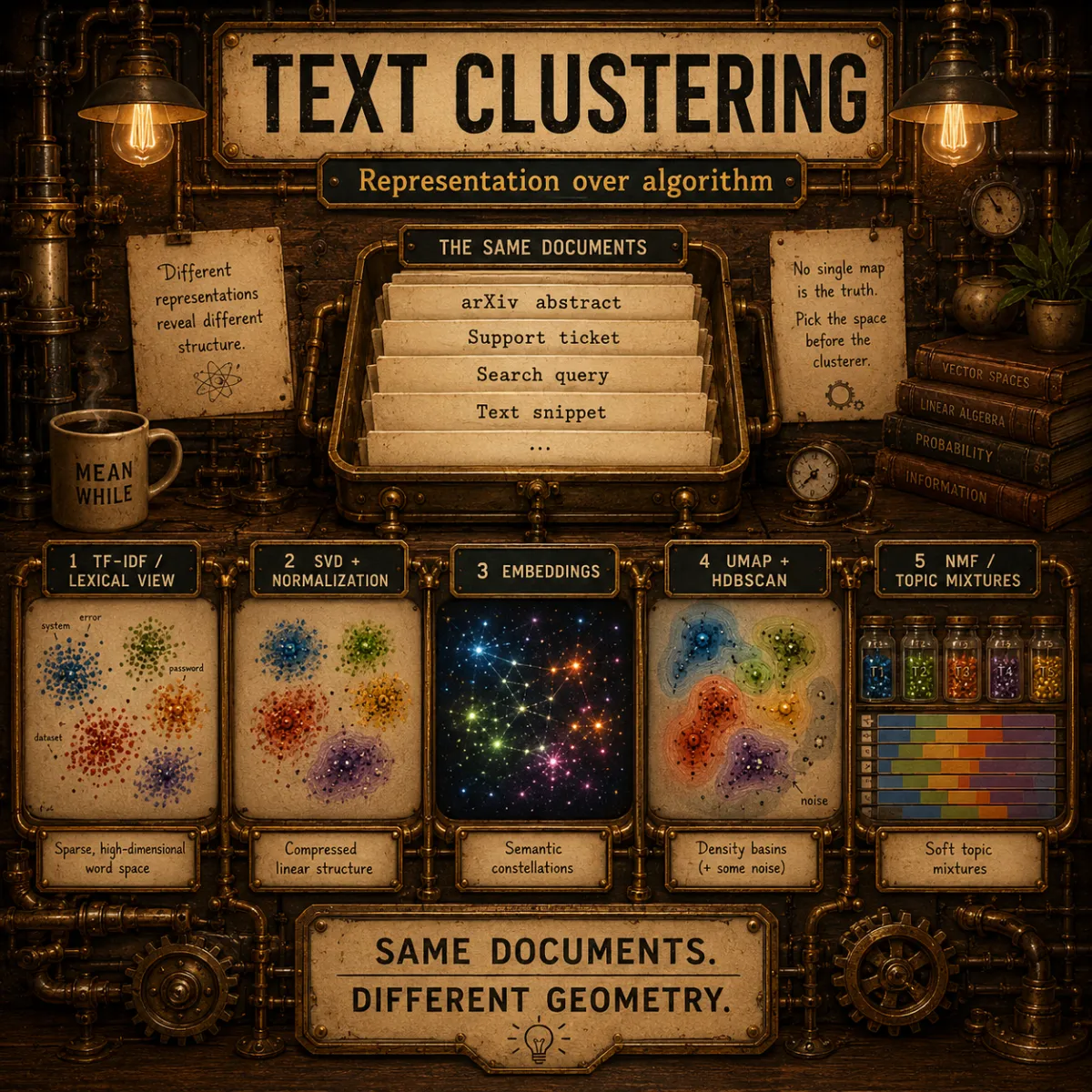
One corpus of arXiv abstracts, clustered nine ways — and the finding that on real text the representation usually decides more than the algorithm.

Read
Jul 3, 2026
Embeddings and Retrieval · Lab

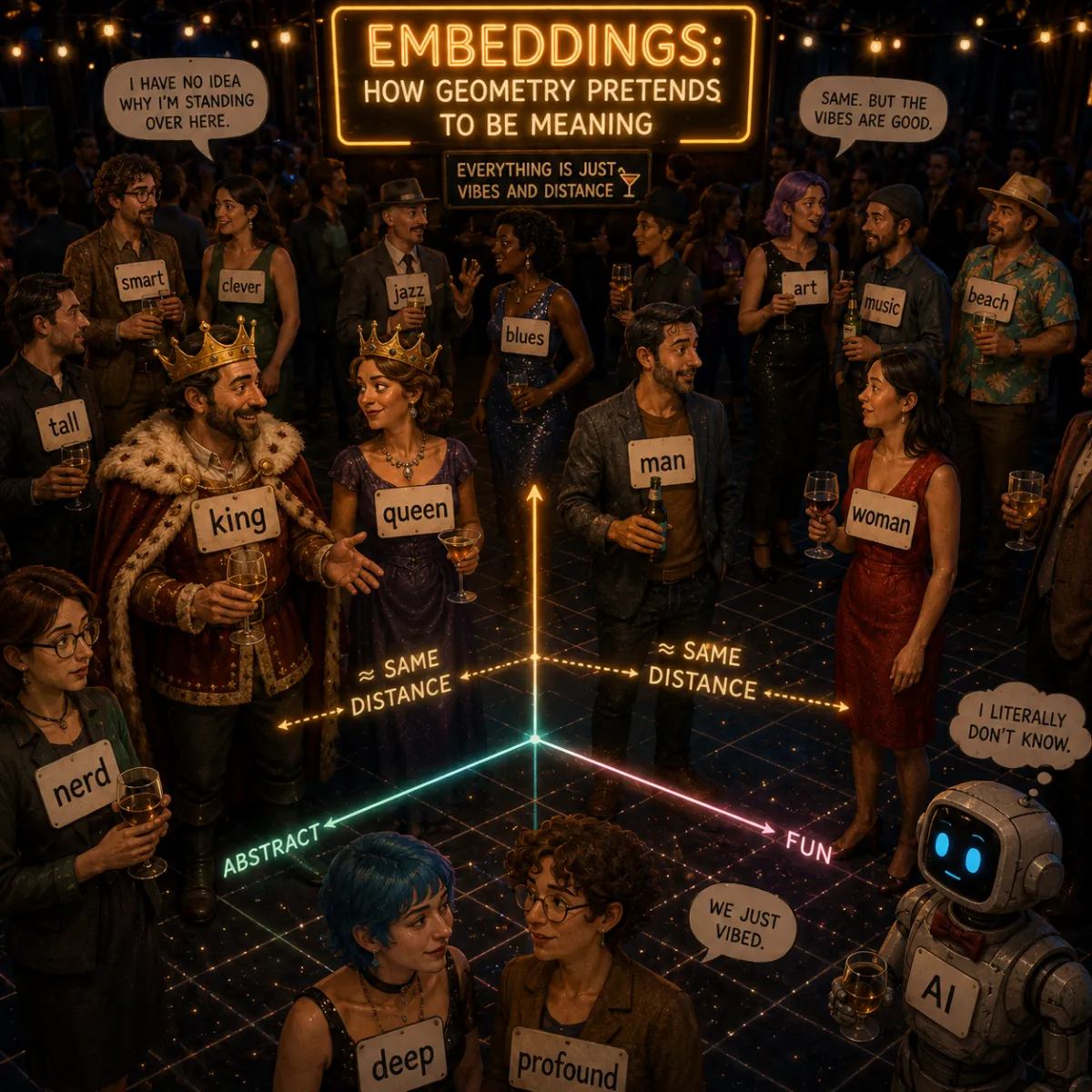
Embeddings: How Geometry Pretends to Be Meaning

Embeddings aren't an encoding of text — they're an attempt to make geometry behave as if it carried meaning. What it means to compress text into a fixed-length vector, how contrastive learning turns statistical structure into distances and directions, why cosine similarity works (and when it stops), how dimension, chunking, context window, and reranking change the physics of a retrieval pipeline, and where embeddings lie usefully.

Read
Jun 8, 2026