lenatriestounderstand

Shorts

See all 28 shorts
Shorts

SFT: Imitation, and the Ceiling It Hits

Supervised fine-tuning is the imitation step of post-training: show the model (prompt → ideal answer) pairs and minimize cross-entropy on the target tokens. It teaches the format of being an assistant — and hits a ceiling that preference learning exists to break.

  • sft
  • fine-tuning
  • post-training
  • instruction-tuning
Read
Jun 16, 2026
Shorts

RLHF: From Likelihood to Preference in Three Stages

Reinforcement Learning from Human Feedback is how a model is bent from optimizing likelihood to optimizing preference: an SFT base, a reward model trained on human comparisons, and a policy optimized against that reward under a KL leash.

  • rlhf
  • reward-model
  • ppo
  • preference-learning
Read
Jun 16, 2026
Shorts

RLAIF: When the Labeler Is a Model

Reinforcement Learning from AI Feedback swaps the human labeler for a model: a capable model judges which of two responses is better, and those AI preferences train the reward. Constitutional AI is its most influential form — and the values don't disappear, they move and become explicit.

  • rlaif
  • constitutional-ai
  • reward-model
  • alignment
Read
Jun 16, 2026
Shorts

What is Grouped-Query Attention (GQA)?

GQA sits between full multi-head attention and MQA: query heads are partitioned into a small number of groups, and each group shares one K/V set. Most of the KV-cache savings of MQA, most of the head diversity of MHA — and a cheap conversion path from existing checkpoints.

  • llm
  • attention
  • gqa
  • kv-cache
Read
Jun 7, 2026

Latest long reads

See all 37 notes
LLM

How LLMs Learn Human Preferences: RLHF, RLAIF and Beyond

How a next-token predictor is bent toward what humans prefer: reward modeling, PPO, RLAIF/Constitutional AI, and the offline-preference family — and why so much of a model's 'personality' and 'emotional' behavior is decided in this stage.

  • rlhf
  • rlaif
  • reward-model
  • ppo
  • +1
Read
Jun 15, 2026
LLM

Why Different Models Feel Like Different Personalities

Same engine, different knobs: why one model reads as warm and another as businesslike. Traces 'personality' to concrete training choices — data mix, preference guidelines, reward model, safety tuning, character training — and folds in sycophancy as a personality artifact of RLHF.

  • personality
  • rlhf
Read
Jun 15, 2026
LLM

Why LLMs Sound Emotional — and Whether They Understand Emotion

Two halves of one question. Why an LLM's emotional language is generated, not felt, and where it comes from — preference data, reward models, safety tuning, system prompts; and whether it can actually understand emotion in others — theory of mind, the recognition benchmarks, and where the fluent performance turns brittle.

  • emotion
  • empathy
  • safety-tuning
  • theory-of-mind
Read
Jun 15, 2026
Embeddings and Retrieval
Lab inside

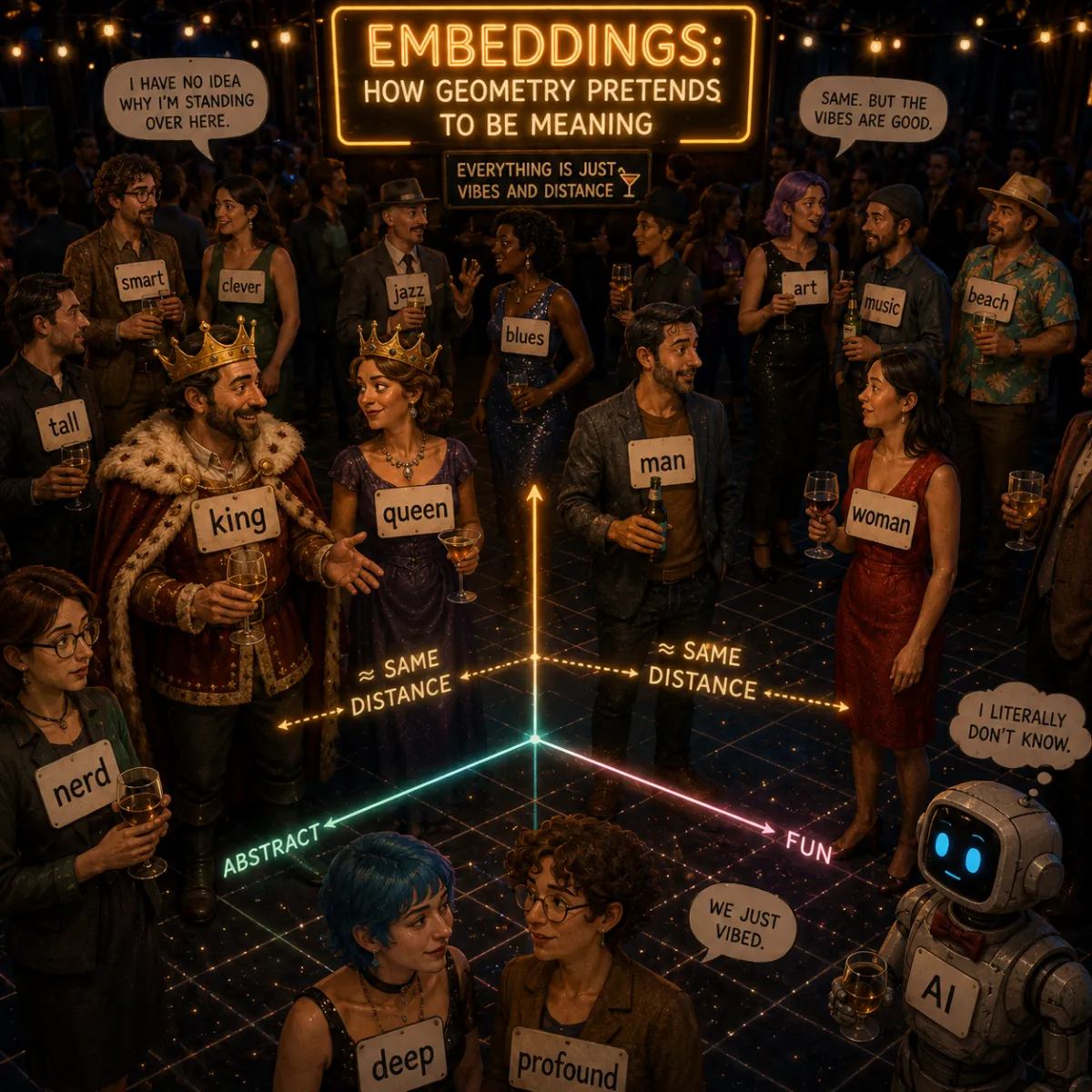
Embeddings: How Geometry Pretends to Be Meaning

Embeddings aren't an encoding of text — they're an attempt to make geometry behave as if it carried meaning. What it means to compress text into a fixed-length vector, how contrastive learning turns statistical structure into distances and directions, why cosine similarity works (and when it stops), how dimension, chunking, context window, and reranking change the physics of a retrieval pipeline, and where embeddings lie usefully.

  • embeddings
Read
Jun 8, 2026

Categories

Favorites

LLM

Why LLMs Sound Emotional — and Whether They Understand Emotion

Two halves of one question. Why an LLM's emotional language is generated, not felt, and where it comes from — preference data, reward models, safety tuning, system prompts; and whether it can actually understand emotion in others — theory of mind, the recognition benchmarks, and where the fluent performance turns brittle.

  • emotion
  • empathy
  • safety-tuning
  • theory-of-mind
Read
Jun 15, 2026
LLM

Why Different Models Feel Like Different Personalities

Same engine, different knobs: why one model reads as warm and another as businesslike. Traces 'personality' to concrete training choices — data mix, preference guidelines, reward model, safety tuning, character training — and folds in sycophancy as a personality artifact of RLHF.

  • personality
  • rlhf
Read
Jun 15, 2026
Embeddings and Retrieval
Lab inside

Embeddings: How Geometry Pretends to Be Meaning

Embeddings aren't an encoding of text — they're an attempt to make geometry behave as if it carried meaning. What it means to compress text into a fixed-length vector, how contrastive learning turns statistical structure into distances and directions, why cosine similarity works (and when it stops), how dimension, chunking, context window, and reranking change the physics of a retrieval pipeline, and where embeddings lie usefully.

  • embeddings
Read
Jun 8, 2026
Econometrics

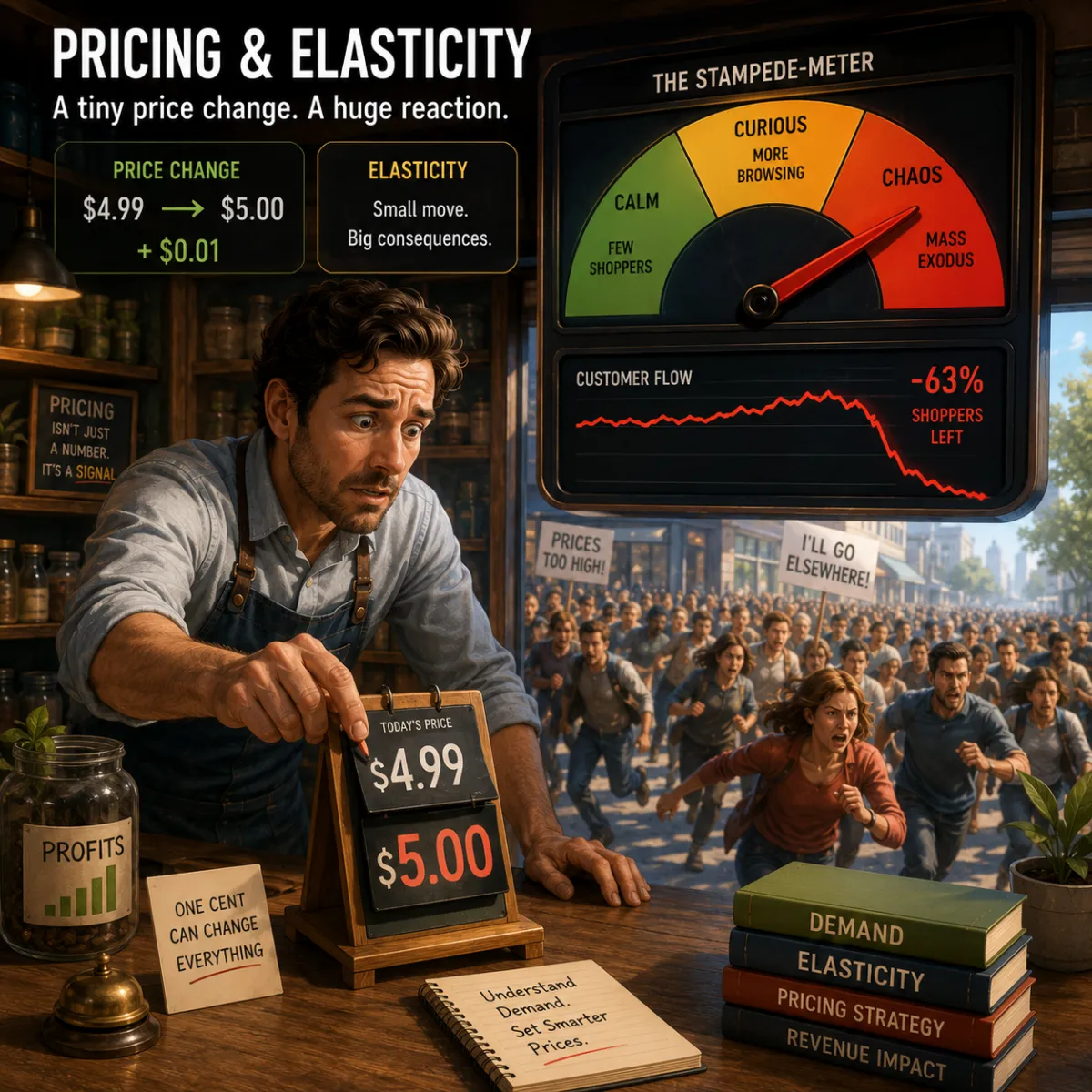
Pricing and Elasticity

Pricing as the worked-example for the Econometrics track — why price is endogenous, the identification strategies (IV, FE, RD, DML, CATE), cross-price elasticity and cannibalization, and what-if analysis with its constant-elasticity caveats.

  • pricing
  • elasticity
  • demand
  • causal-inference
Read
Jun 7, 2026
Econometrics

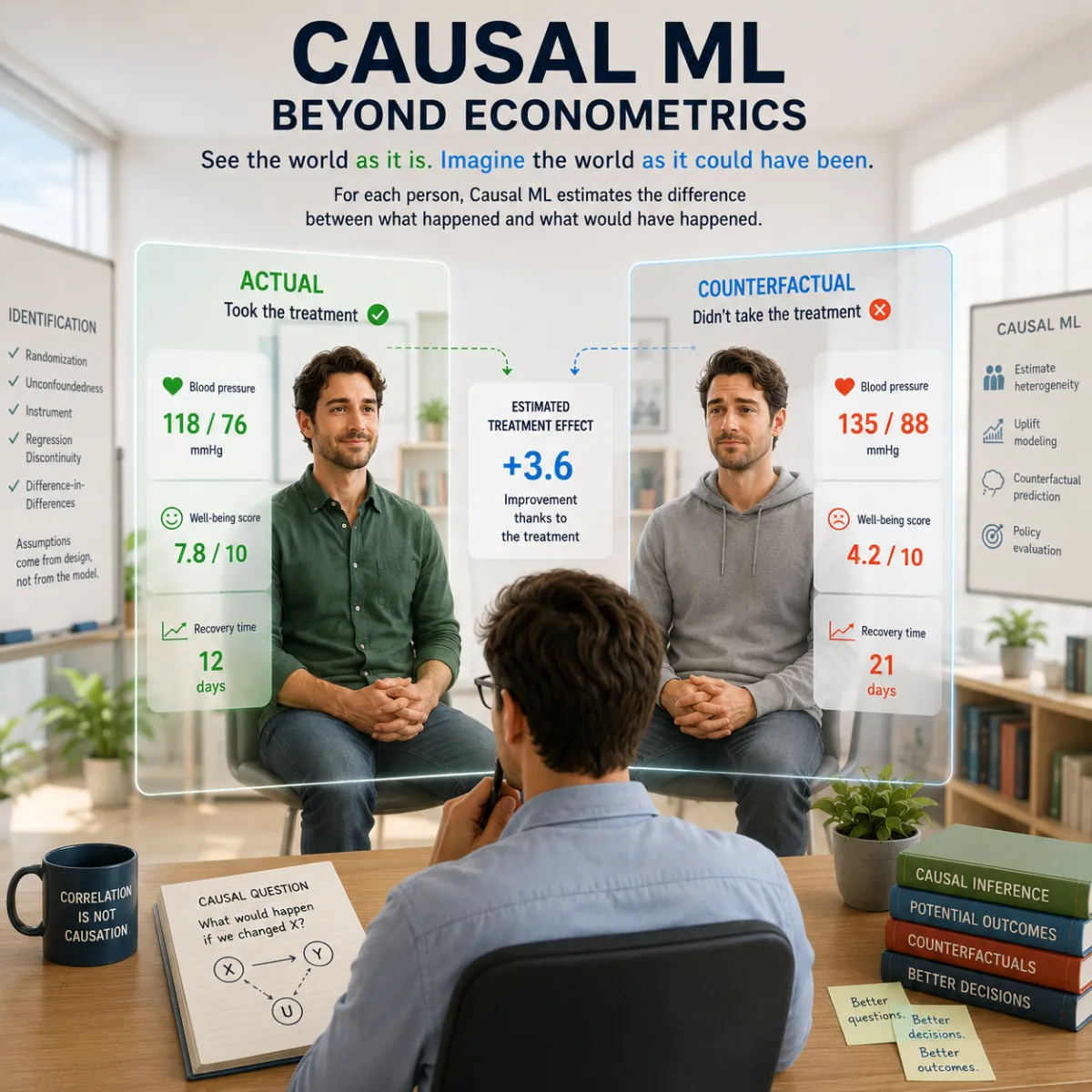
Causal ML Beyond Econometrics

Causal ML at the meeting point of econometrics and ML — ATE vs CATE, uplift modelling, DML and orthogonal-moments inference, causal forests, counterfactual prediction, off-policy evaluation, and the standard mistakes from treating predictive models as causal.

  • causal-ml
  • uplift
  • dml
  • cate
Read
Jun 7, 2026
LLM

Fine-Tuning LLMs: When the Weight Delta Is Worth It

Fine-tuning is not prompt repair. It is a decision to write a reusable parameter delta into an existing checkpoint. That delta changes future logits, defaults, and trade-offs. This note is about when that is worth doing: what fine-tuning actually buys, how to tell whether a gap belongs in the weights, and why data, evals, forgetting, and probability shape matter more than the slogan 'just fine-tune it'.

  • fine-tuning
  • residual-stream
Read
May 30, 2026
Embeddings and Retrieval

Chunking Strategies

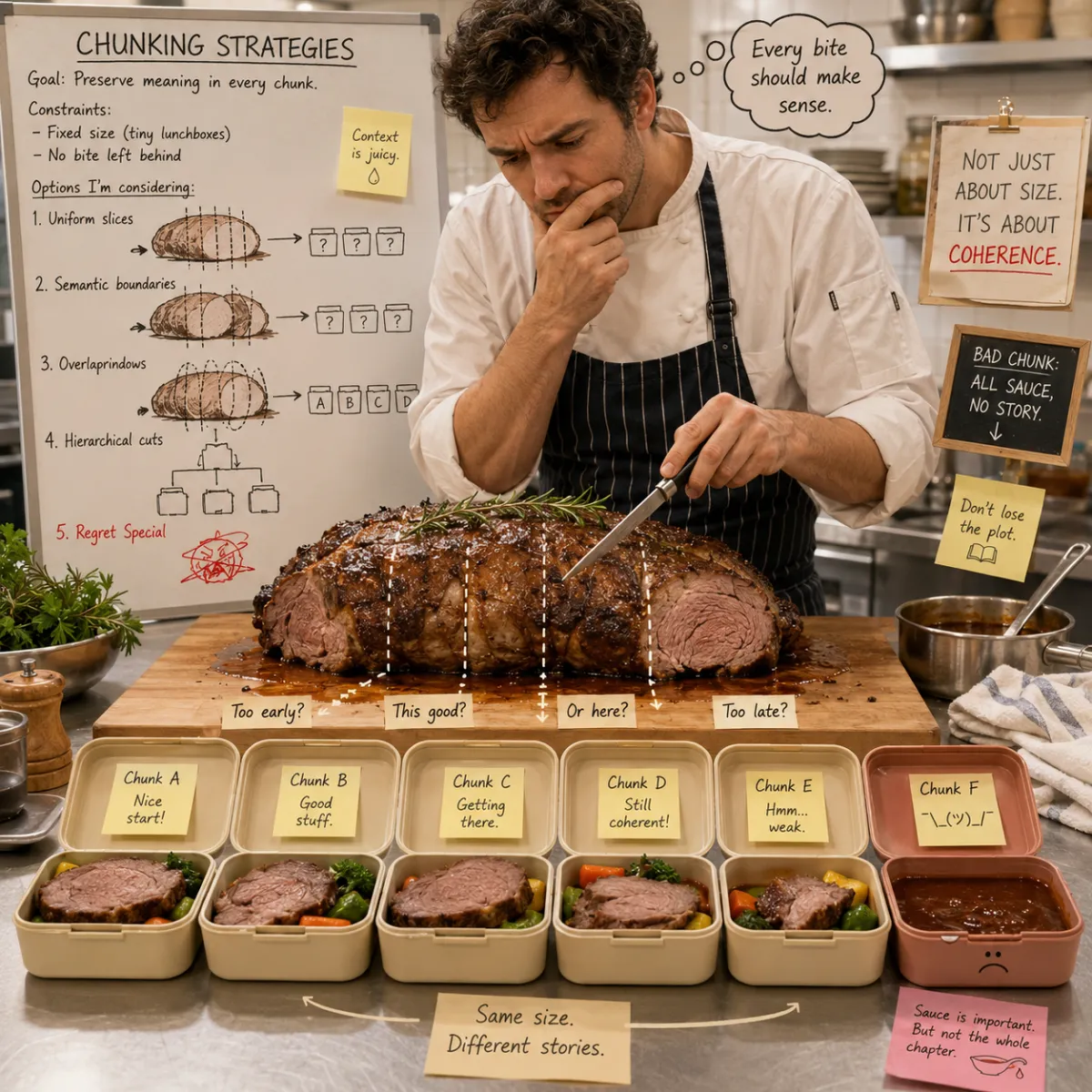
Chunking turns out to be more architectural than it looks. A walk through what a chunk has to satisfy at six different stages simultaneously, what RecursiveCharacterTextSplitter actually does under the hood, and what the 2024–2026 toolbox — late chunking, contextual retrieval, contextualized chunk embeddings, BGE-M3 multi-functionality, ColBERT late interaction — is actually for.

  • chunking
  • rag
Read
May 26, 2026
Embeddings and Retrieval

How Text Became Geometry

Sixty years of incremental work behind the modern embedding vector. From bag-of-words and BM25, through Word2Vec's distributional hypothesis, to contextual embeddings and contrastive retrieval models. The point isn't trivia — it's that each older idea is still in production today, and the picture only makes sense once you've seen the road that led here.

  • embeddings
  • history
  • retrieval
Read
May 21, 2026
LLM

The Hindsight Corpus: Time in LLM Pretraining Data

Saying a model was 'trained on text written before T' invites a picture of human knowledge as of T. The actual corpus is volumetrically skewed toward recent years, dominated by retroactively-edited sources like Wikipedia, missing reliable per-document timestamps, and survivor-biased for older periods. The mechanisms, the failure modes that fall out, what's silently absent from datasheets, and what time-aware pretraining would have to do differently.

  • pretraining
  • training-data
  • temporal
Read
May 13, 2026
LLM

The Missing Now: Temporal Grounding in LLM Agents

A chat transcript preserves order but not elapsed time, world state, or whether earlier hypotheses have expired. For long-running agents, temporal grounding is a runtime problem, not a model problem — what 'now' actually is, the failure modes that fall out when context gets treated as state, the primitives (clocks, event logs, state reducers, expectations, monitors) that close the gap, and how to measure whether it works.

  • agents
  • temporal-grounding
  • state-management
Read
May 13, 2026
LLM

The Physics of Hallucination

What hallucination looks like at the level of the transformer's internal computation — distributed representations, signal competition in the residual stream, the softmax bottleneck, the activation-output gap, and the architectural reasons there is no first-class epistemic channel.

  • hallucinations
Read
May 8, 2026