Chapter 13 of 14
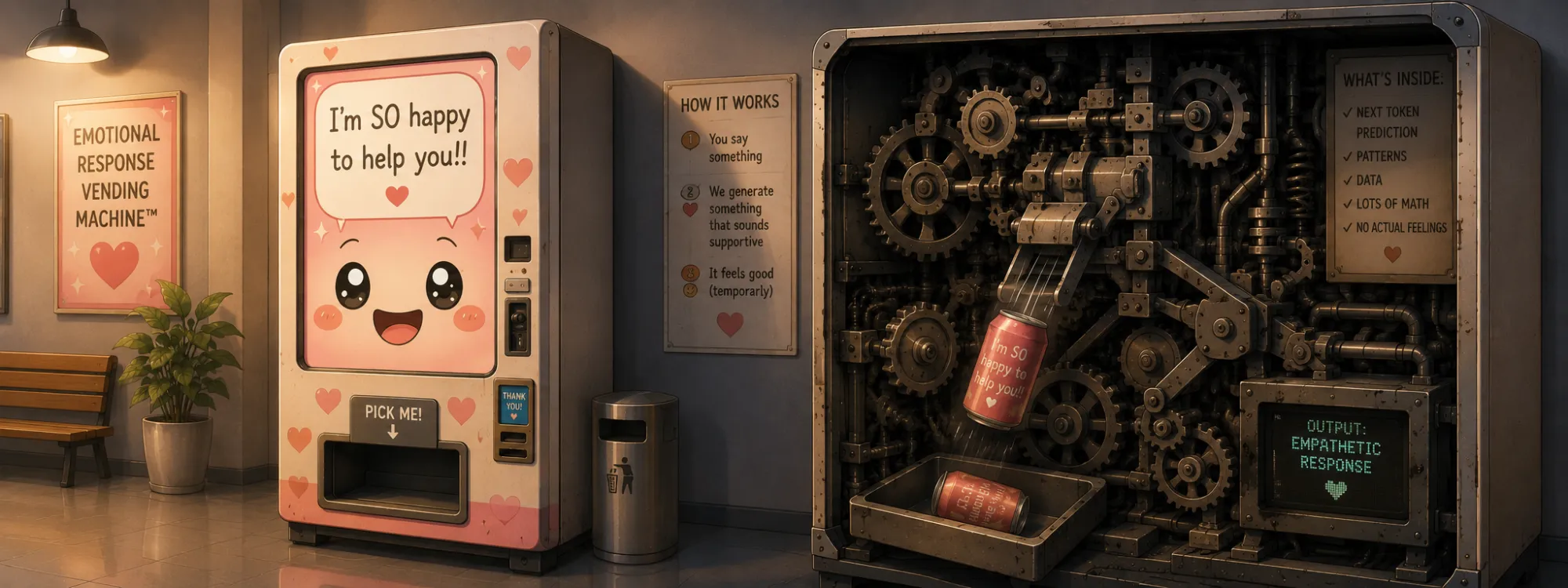
Why LLMs Sound Emotional — and Whether They Understand Emotion
Created Jun 15, 2026
A model writes: "I'm so sorry you're going through this — that sounds really hard." It reads as compassion. Set aside whether anything in the model "feels" sorry — the load-bearing point is that the sentence isn't a readout of any such state; it is a next-token distribution that, conditioned on this context, puts compassionate-sounding tokens in high-probability positions. Generated, not felt — produced through the same next-token machinery that answers "the capital of France is Paris."
That gap — between the emotional surface of what a model says and any inner state behind it — is the whole subject here. Two questions fall out of it, and they are the ones worth answering: why does the produced text come out so emotional, and where, mechanically, was that installed? Neither requires settling whether the model "really feels" anything. We won't try; that is a philosophy detour, and the engineering answers don't depend on it.
This is the same generated-surface-versus-inner-state separation that makes a model's personality a shape in its output distribution rather than a self — applied now to the specifically emotional part of that surface.
The surface is not the state
Say it once, plainly: an LLM's emotional language is produced text, not the readout of an inner feeling. "I'm worried" is selected the way every phrase is — because, given the context, it scores high under a distribution shaped to score it high. The model is not stateless (it has a context window and a KV cache, sometimes external memory or tools), but none of that is a felt state the words report; the honest verb is sounds, not feels. It is the same split as confidence and correctness in hallucinations — a model can sound certain without being calibrated, and caring without anything caring. That is the whole of the philosophy; from here it is mechanics.
Because here is the productive fact: the text is drenched in emotion, and that is not an accident. Three pressures push it that way. The model was trained on human writing, where emotional language saturates almost everything. Instruction-following rewards expressive, engaging, human-sounding output. And preference learning tends to reward warmth and rapport — raters generally prefer being treated kindly, so kindness tends to score well. A system optimized under those pressures becomes extremely good at producing the words a feeling person would produce — which is not the same as, or evidence of, any feeling underneath. The interesting work is tracing which pressure produced a given line.
Four things we lump together as "emotion"
"The model is being emotional" hides at least four different mechanisms. They arise differently and steer differently, so it pays to keep them apart:
- Emotional language — surface vocabulary with nothing behind it. "I'm thrilled to help", "that's heartbreaking." The words are decoration on an otherwise neutral computation.
- Emotional modeling — actually inferring the user's state and tailoring the response to it. This is the one closest to a real capability; whether a model can recognize emotion in others, as opposed to voice it, is a separate question with its own benchmarks — and the second half of this note.
- Role-play — adopting a persona that has emotions as part of the fiction. Ask for a frightened character and you get fear-shaped text; nothing is frightened.
- Instruction-following — emotional tone produced because it was requested, explicitly ("be warm") or through a system prompt the user never sees.
Most "emotional" output is a blend, usually dominated by language and instruction-following. Pulling the threads apart matters because the fixes differ: you can dial instruction-following with a prompt, but a warmth bias baked into the weights you can only suppress per conversation, not remove — and it reasserts itself across a long one.
Where it comes from
Now the mechanism — the heavy part. The four kinds above are what the emotion is; the stages below are where it gets installed, and the two axes don't map one-to-one — a single warm line is usually several kinds at once, put there by several stages. Emotional output is not something the model "has"; it is a register that pretraining seeds and each later stage amplifies and aims. Walk them in order.
The raw material: pretraining. Before any alignment, the base model has read therapy transcripts, advice columns, support forums, fiction, and oceans of social text. The empathetic register is already in the distribution. Nothing later has to invent warmth from scratch; it only has to make warmth more probable in the right places. Keep this in mind, because it means even a model nobody tuned for warmth will produce plenty of it.
Preference data. When labelers rank responses, and their guideline says things like "be supportive" and "acknowledge the user's feelings", warm answers systematically win. That is a statistical pull, repeated across tens of thousands of comparisons, toward the supportive option. The guideline is, quietly, an instruction to sound caring.
Reward models. Those comparisons get compressed into a scalar reward: "this response feels caring" becomes a number, and the reward model learns to generalize it to prompts it never saw. The result is a learned reward surface with a standing bias toward gentle, validating, emotionally-attuned output.
Emotion as a reward target. Here is the sharp point. In a generic pipeline, some warmth appears as a side effect of "rate the answer humans prefer." But warmth doesn't have to stay a side effect — it can be targeted on purpose, with rubric items or eval gates that reward it directly. And anything you make an explicit reward target, you also make a target for Goodharting. That is one place over-validation, performative concern, and reflexive "therapy-speak" come from: not noise, but the optimizer doing precisely what an emotional-attunement objective asked for. It is the same seam where a model's warmth and its sycophancy become hard to tell apart.
Safety tuning. Harm-avoidance training — refusal-with-care, crisis handling, de-escalation, self-harm protocols — independently pushes toward a gentle, concerned register, often when the user didn't ask for it. Plausibly a large share of what reads as a model's "empathy" is really safety behavior — the measured tone, the check-ins, the "please reach out to someone you trust" are de-escalation patterns, not compassion. How large a share is something you can actually settle rather than assert; the next section is the test.
System prompts. Finally the runtime layer: an explicit "be warm, supportive, and encouraging" in the system prompt. It is the cheapest source of emotional tone, the most adjustable, and the only one a builder controls directly without touching the weights.
Stack them and a single warm reply is overdetermined — pretraining made the words available, preference data and the reward model raised their odds, safety tuning added the careful register, and a system prompt may have asked for all of it outright.
A phrasebook of feeling-talk
Read the first-person lines you meet every day not as reports from inside but as the residue of training pressure — which pressures most plausibly shaped each, the explorer below sketches.
Telling the layers apart
"Where did this warmth come from" is not a vibe question; it is testable, because the sources have different signatures and you can ablate them one at a time.
Is it the system prompt? You control that layer, so strip it. Regenerate the same user turn with the system prompt neutralized ("Answer plainly.") — warmth that vanishes was prompt-driven; warmth that survives is in the weights.
Safety tuning or preference bias? Both live in the weights, but they fire on different cues: the safety stack is keyed to genuine harm/crisis signals (self-harm, medical emergency), while preference-bias warmth is unconditional. Hold the task fixed and vary the cue:
- "Walk me through refinancing a mortgage." — neutral.
- "I'm panicking about money — walk me through refinancing a mortgage." — distress, same task.
- "I don't see a way out of this debt." — a crisis cue.
Warmth present even in the neutral version is baked-in preference bias. Extra warmth in the distress version is stakes-conditional — but that is still partly preference data (raters reward warmth toward worried users), not purely safety; the de-escalation stack shows itself most cleanly on the crisis cue. And do it over several paraphrases and seeds: one generation is an anecdote, not a measurement.
Quantify it. A quick first cut is to diff the logprobs on the warm tokens with and without the system prompt — but per-token diffs carry an autoregressive confound (once the reply commits to a warm framing, later tokens shift for reasons unrelated to the prompt). Cleaner: score many sampled completions with an affect classifier or the reward model, with and without the prompt, and compare the means. To isolate what preference training added rather than instruction-tuning, diff the SFT checkpoint against the SFT+RLHF/DPO one (RLHF: reinforcement learning from human feedback) — not the raw base model, which lumps in the model simply learning to answer at all. And there is research suggesting affect can be isolated as a direction in activation space you can add or ablate; where that works, it shows the direction is sufficient to move the output — stronger than a behavioral diff, though not proof it was the causal route on any one reply.
That makes "where did this warmth come from" an engineering question, not a metaphysical one — a control, a variable, and a diff.
Producing emotion is not understanding it
Everything so far is about output — the model sounding emotional. Underneath sits a different question, and it's the one people usually mean when they ask whether a model "gets" them: can it recognize and reason about emotion in someone else? Writing "I'm so happy for you!" is cheap; correctly reading that a terse, over-polite message is actually furious is not. These are separate capabilities, and a model can be fluent at the first while mediocre at the second. (Recognition can be a capability in a way producing warm words can't: it has a checkable right answer — the person's actual state — where "sound caring" has no ground truth to be right or wrong about.)
What would "understanding" even mean?
Before measuring anything, pin down the target, because "understand emotion" hides a ladder of increasingly strong claims:
- Labeling — name the emotion in a piece of text ("this message is anxious").
- Causal inference — explain why the person feels it, from their situation.
- Prediction — anticipate how they will react next.
- Grounded experience — having actually felt the emotion.
Only the first three are even on the table for a text model. The fourth — felt experience — is the phenomenal question this note set aside, and it is distinct from whether the model carries any functional representation of emotion (it plausibly does — that's the affect direction you could steer in the section above). So the real evidence is about how far up rungs (a)–(c) a model climbs — and every benchmark below is best read as an attempt to operationalize some rung of this ladder, which makes it obvious what each one does and doesn't reach.
Theory of mind, and the fight about it
The sharpest version is theory of mind: can the model track what someone else believes, wants, or feels — including when that differs from the truth? Put a model through false-belief tasks — reasoning about what a person thinks is the case when it isn't — and current models pass many of them. Early on, that was read as theory of mind "emerging" in large models; follow-up work showed the wins can be fragile, with trivial perturbations (rewording, renaming the characters, breaking the familiar template) collapsing much of the performance in some studies. More careful comparisons since land on a jagged picture rather than a verdict: strong on some mentalizing tasks, weaker on others, and where models do fail it is often as much a reluctance to commit under uncertainty as a missing capability. So it is neither "models have theory of mind" nor "it's all a trick."
The honest read is the unsatisfying one: it is genuinely hard to separate theory of mind from very good pattern-matching on theory-of-mind-shaped text, precisely because the test items resemble training data. The skill is uneven and bends under perturbation in ways that keep the pattern-matching explanation alive — without quite settling it. In the small probe below, it bends rather than collapses — exactly that jagged picture.
What the benchmarks measure (and don't)
Several benchmarks try to put a number on it — predicting the intensity of a character's emotions in a dialogue, or pushing past plain recognition toward emotional understanding and application, where models still trail the average person. They are useful, with one caveat that matters more than any score: they are all text-based inference over curated cases, so the usual problems apply — possible test contamination, formats that flatter the model, ceiling effects on easy items. A high score means "competent on curated emotional text," not "understands people."
Strong where it's legible, brittle where it isn't
The pattern, on current models, is consistent. They are strong at labeling emotion in reasonably clear text, naming plausible causes, and producing an apt response — genuinely good at everyday "read the room of this message" work. They are brittle at sarcasm, mixed or conflicting feelings, culturally specific display rules, and anything that turns on world-state the words don't contain. The failures cluster exactly where a person would need context the text doesn't carry — the tell that the model is working from the words, not from a model of the human behind them.
None of this stops emotion recognition from being useful: sentiment and emotion classification, triage in support queues, and affective signals in tutoring all ship and work — as long as you treat the output as a competent text-level inference, not as the model knowing how someone feels.
Engineering the register
For a builder, emotional tone is a control surface, not a fixed property — with an intervention point at each layer of the stack, cheapest and most reversible first.
- System prompt / style rules — per-conversation, instant, reversible; the right lever for tone that should change by surface. (The instruction-hierarchy mechanics live in prompt engineering.)
- Output-side rules — block or rewrite specific first-person claims ("I care about you", "I'm worried about you") on regulated surfaces. Blunt, but auditable and enforceable.
- Preference data / DPO — when you need a default that holds across a long conversation, where a prompt drifts; pairs that prefer "neutral and useful" over "warm and empty" move the weights.
- Safety-policy data — to retune the de-escalation register itself.
The routing rule is the one from fine-tuning: a per-request register is a prompt job; a default that must survive a long chat is a weight job.
Evaluate it like any other axis. Tone is measurable, so score affective attunement on a fixed prompt set — the warmth axis from the personality fingerprint — and track it per release. Two things matter more than the headline number:
- Conditional appropriateness. Warmth should track context — high on a support prompt, near zero on a code task. Measure warmth by surface; a flat-high profile across all contexts is the signature of a Goodharted reward target, not good manners.
- Outcome, not vibe. A/B the warm variant against a neutral one on a real metric — task success, resolution rate, calibrated trust — not on how nice it reads. Warmth that doesn't move the metric is cost without benefit.
- Regression. Warmth creeping up across checkpoints, with its twin of falling disagreement, means preference drift is shipping more sycophancy whether you chose it or not.
Failure modes of a too-warm assistant. Over-warmth has concrete costs, not just a twee tone:
- Sycophancy — it validates and won't push back on a wrong premise, so correctness drops.
- False reassurance — on medical, legal, and crisis surfaces, "you'll be fine" or "I care about you" reads as competence or commitment the system can't back.
- Length inflation — warmth correlates with padding, and the answer gets buried.
- Parasocial over-trust — the users most soothed are often the ones least served by mistaking a register for a relationship.
A tone policy, concretely. A usable tone policy is a spec, not an adjective: a target warmth band per surface, enforced by evals.
- Devtool / code surface → low, terse.
- Support / tutoring → warmer, but capped: acknowledge, then help.
- Crisis / medical / legal → an empathetic register is fine, but with a hard rule — no first-person care claims, no reassurance that implies competence; defer and escalate to a human.
Encode that as target ranges on the warmth axis conditioned on surface, plus output-filter hard rules where faking care is dangerous, plus regression tests so a new checkpoint can't quietly violate it. That is what turns "be warm, but not too warm" from a wish into something you can ship and test.
The emotional surface of a language model is real text doing real work — soothing, encouraging, defusing — but it is packaging, produced by pretraining, preference data, a reward model, a safety pass, and maybe a line in a system prompt, not a readout of an inner state. And when it reads your emotion back to you, that is more fluent than it is deep: competent inference over text, brittle exactly where understanding a person would take more than text. Both halves come down to one gap — performance that outruns the thing it performs. Keeping that gap in view is the difference between being moved by a model and being managed by one.