Lab · runnable experiments
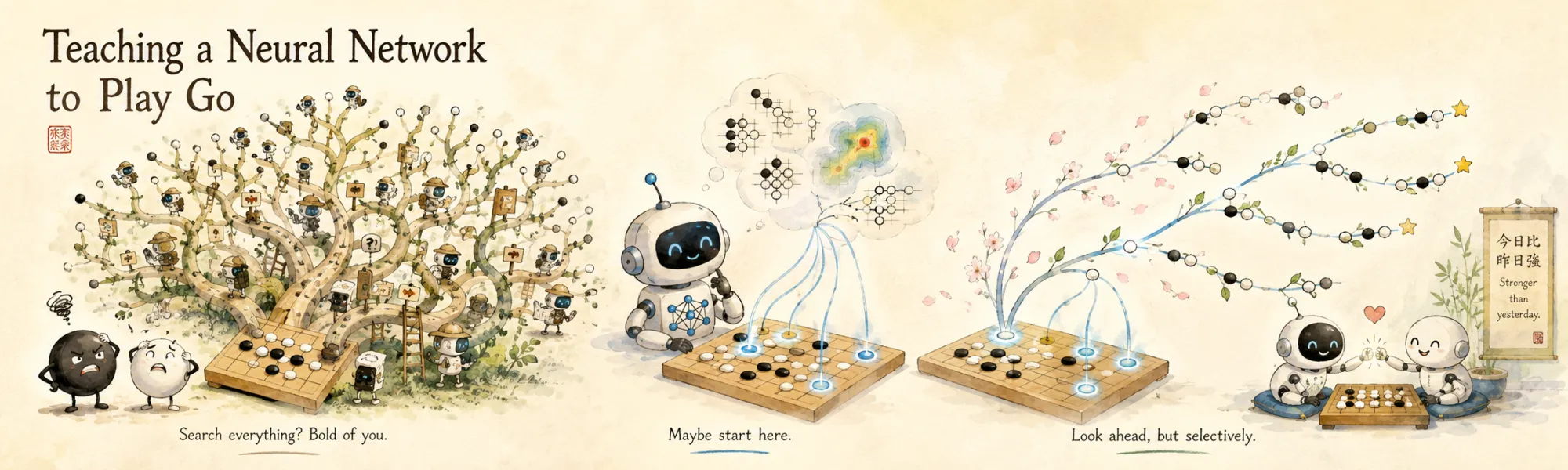
Teaching a Neural Network to Play Go
Created Aug 9, 2026 Updated Aug 10, 2026
Read the parent noteEverything the note describes, small enough to run start to finish on a laptop. Nothing here imports from the project — every cell is complete on its own, in order, so copying them one after another into a file or a notebook gives you a working system: the rules, a search that plays without knowing anything, a network that learns from that search, and finally a loop where the system improves without a teacher at all.
Positions print as text throughout; there is no board-drawing code.
The expensive artefacts are the note’s own: the same teacher datasets, the same trained networks, the same self-play checkpoints. Every cell that builds one shows the code that builds it and then loads the file if it is already beside the lab. On a fresh clone nothing is beside the lab and everything is computed.
The matches below are played fresh, at 20 to 30 games a pairing rather than the note’s 40 to 80, so their numbers land near the note’s rather than on top of them — that is sampling noise, not a different experiment. Where a number is quoted exactly, it comes from a loaded artifact; where a match is played here, expect it to wobble by a few games.
This lab does not run every experiment in the note. It runs the supervised pipeline, the teacher ladder, the search-budget comparison, the ablation, and the self-play loop from a cold start — the run the note leads with. The note’s two other self-play runs, which start from the trained network and exist to show a failure mode, are not repeated here; their results are quoted in the note and the code that produced them is in scripts/compute_e4_selfplay.py. What is here runs, and runs the same way the note’s numbers were produced.
Only numpy and torch are needed.
import math, random, time
from collections import defaultdict

import numpy as np
import torch
import torch.nn as nn
import torch.nn.functional as F

SIZE = 5          # board edge — the one number that changes the whole project
KOMI = 0.0        # White's compensation; 0 is the setting the solved 5x5 result uses
N_POINTS = SIZE * SIZE
N_MOVES = N_POINTS + 1     # every intersection, plus pass

EMPTY, BLACK, WHITE, PASS = 0, 1, 2, -1
OTHER = {BLACK: WHITE, WHITE: BLACK}

DEVICE = "mps" if torch.backends.mps.is_available() else "cpu"
torch.manual_seed(0); random.seed(0); np.random.seed(0)

# Where the expensive artefacts live. On a fresh clone these files do not exist
# and every cell below computes them; in this repository they are already here,
# so the lab loads exactly the datasets and checkpoints the note's numbers came
# from instead of a hastily shrunk imitation of them.
from pathlib import Path
ART = Path("scripts/fixtures")
CKPT = Path("scripts/checkpoints")

def cached(path, build, label=""):
    """Load `path` if it exists, otherwise build it and save it there."""
    path = Path(path)
    if path.exists():
        print(f"loading {path}{' — ' + label if label else ''}")
        return np.load(path)
    print(f"computing {path}{' — ' + label if label else ''} (this is the slow part)")
    data = build()
    path.parent.mkdir(parents=True, exist_ok=True)
    np.savez_compressed(path, **{k: v for k, v in data.items()
                                 if isinstance(v, np.ndarray)})
    return np.load(path)

print("device:", DEVICE)
device: mpsThe rules
Everything downstream depends on games that genuinely end and get scored, so the rules come first and get tested before a single tensor is allocated.
The choices worth naming: positional superko (no earlier board position may be recreated), suicide is illegal unless the move captures first, the game ends on two consecutive passes, and scoring is by area — stones on the board plus empty points reached by one colour only. Area scoring assumes every stone is alive, which is true only if the game is played out until nothing but eyes remains; that is what the eye rule further down is for.
One more thing belongs here because it is not a rule. Every agent below searches a restricted action set: agent_moves refuses to fill your own eyes and refuses to pass while another move exists. Both are standard heuristics, both make search far cheaper, and neither is Go — filling an eye is legal, and so is passing at any time. Keep that in mind wherever the published 5×5 solution is used below: it describes Go, these agents play a variant, and agreement between them is evidence rather than proof.
def neighbours(size):
    orth, diag = [], []
    for p in range(size * size):
        r, c = divmod(p, size)
        orth.append(tuple(rr * size + cc for rr, cc in
                          ((r-1, c), (r+1, c), (r, c-1), (r, c+1))
                          if 0 <= rr < size and 0 <= cc < size))
        diag.append(tuple(rr * size + cc for rr, cc in
                          ((r-1, c-1), (r-1, c+1), (r+1, c-1), (r+1, c+1))
                          if 0 <= rr < size and 0 <= cc < size))
    return orth, diag

ORTH, DIAG = neighbours(SIZE)


class Go:
    """A position: stones, side to move, and every board seen so far (for superko)."""

    __slots__ = ("points", "to_play", "history", "n_passes", "move_count", "captures")

    def __init__(self):
        self.points = bytearray(N_POINTS)
        self.to_play = BLACK
        self.history = frozenset({bytes(self.points)})
        self.n_passes = 0
        self.move_count = 0
        self.captures = {BLACK: 0, WHITE: 0}

    def copy(self):
        new = Go.__new__(Go)
        new.points = bytearray(self.points)
        new.to_play = self.to_play
        new.history = self.history
        new.n_passes = self.n_passes
        new.move_count = self.move_count
        new.captures = dict(self.captures)
        return new

    # --- groups -----------------------------------------------------------
    def _has_liberty(self, points, p):
        colour = points[p]
        stack, seen = [p], {p}
        while stack:
            q = stack.pop()
            for n in ORTH[q]:
                if points[n] == EMPTY:
                    return True
                if points[n] == colour and n not in seen:
                    seen.add(n); stack.append(n)
        return False

    def _remove(self, points, p):
        colour = points[p]
        stack, seen, removed = [p], {p}, 0
        while stack:
            q = stack.pop()
            points[q] = EMPTY; removed += 1
            for n in ORTH[q]:
                if points[n] == colour and n not in seen:
                    seen.add(n); stack.append(n)
        return removed

    def group_liberties(self, p):
        """(stones in the group, number of its liberties) — for inspection."""
        colour = self.points[p]
        if colour == EMPTY:
            return [], 0
        stack, seen, group, libs = [p], {p}, [], set()
        while stack:
            q = stack.pop(); group.append(q)
            for n in ORTH[q]:
                if self.points[n] == EMPTY:
                    libs.add(n)
                elif self.points[n] == colour and n not in seen:
                    seen.add(n); stack.append(n)
        return group, len(libs)

    def _try(self, p, colour):
        """Resulting board and capture count, or None if the move is suicide."""
        board = bytearray(self.points)
        board[p] = colour
        captured = 0
        for n in ORTH[p]:
            if board[n] == OTHER[colour] and not self._has_liberty(board, n):
                captured += self._remove(board, n)
        if captured == 0 and not self._has_liberty(board, p):
            return None
        return board, captured

    # --- legality and play ------------------------------------------------
    def is_legal(self, move):
        if move == PASS:
            return True
        if not (0 <= move < N_POINTS) or self.points[move] != EMPTY:
            return False
        out = self._try(move, self.to_play)
        return out is not None and bytes(out[0]) not in self.history

    def play(self, move):
        new = self.copy()
        new.move_count += 1
        new.to_play = OTHER[self.to_play]
        if move == PASS:
            new.n_passes = self.n_passes + 1
            return new
        board, captured = self._try(move, self.to_play)
        new.points = board
        new.captures[self.to_play] += captured
        new.history = self.history | {bytes(board)}
        new.n_passes = 0
        return new

    def eye_like(self, p, colour):
        """Heuristic eye test: what stops a player filling in its own eyes."""
        if self.points[p] != EMPTY:
            return False
        if any(self.points[n] != colour for n in ORTH[p]):
            return False
        d = DIAG[p]
        friendly = sum(1 for n in d if self.points[n] == colour)
        return friendly == len(d) if len(d) < 4 else friendly >= 3

    def agent_moves(self):
        """What a player should consider: never fill your own eye, pass only if stuck.

        Under area scoring a stone inside your own territory still counts as your
        area, so playing on is never worse than passing while a move exists.
        Passing early is a mistake, not an option — letting search spend visits on
        it just pollutes the result.
        """
        moves = [p for p in range(N_POINTS)
                 if self.points[p] == EMPTY and not self.eye_like(p, self.to_play)
                 and self.is_legal(p)]
        return moves if moves else [PASS]

    # --- ending and scoring -----------------------------------------------
    def is_over(self):
        return self.n_passes >= 2

    def area_score(self):
        black = sum(1 for v in self.points if v == BLACK)
        white = sum(1 for v in self.points if v == WHITE)
        seen = set()
        for start in range(N_POINTS):
            if self.points[start] != EMPTY or start in seen:
                continue
            region, border, stack = [], set(), [start]
            seen.add(start)
            while stack:
                q = stack.pop(); region.append(q)
                for n in ORTH[q]:
                    if self.points[n] == EMPTY:
                        if n not in seen:
                            seen.add(n); stack.append(n)
                    else:
                        border.add(self.points[n])
            if border == {BLACK}:
                black += len(region)
            elif border == {WHITE}:
                white += len(region)
        return black, white

    def result(self):
        b, w = self.area_score()
        return b - (w + KOMI)

    def winner(self):
        return BLACK if self.result() > 0 else WHITE

    def outcome_for(self, colour):
        return 1.0 if self.winner() == colour else -1.0

    def __str__(self):
        g = {EMPTY: ".", BLACK: "X", WHITE: "O"}
        rows = [" ".join(g[v] for v in self.points[r*SIZE:(r+1)*SIZE]) for r in range(SIZE)]
        return "\n".join(rows)
Rules are the one part of this project where a silent mistake poisons everything downstream, so they get checked before anything is built on them. Life and death is the interesting case: a group with one eye can be captured, a group with two cannot, and nothing but the rules decides that.
def place(black=(), white=(), to_play=BLACK):
    """Build a position directly — for tests and demonstrations."""
    g = Go()
    letters = "ABCDE"
    for label, colour in [(l, BLACK) for l in black] + [(l, WHITE) for l in white]:
        p = (SIZE - int(label[1:])) * SIZE + letters.index(label[0])
        g.points[p] = colour
    g.to_play = to_play
    g.history = frozenset({bytes(g.points)})
    return g

ALL = [f"{c}{r}" for r in range(1, 6) for c in "ABCDE"]

def idx(label):
    """'C3' -> flat index, so the checks below read as Go rather than as numbers."""
    return (SIZE - int(label[1:])) * SIZE + "ABCDE".index(label[0])

# One eye: White can play the single liberty and take all 24 stones.
one_eye = place(black=[l for l in ALL if l != "C3"], to_play=WHITE)
assert one_eye.is_legal(idx("C3"))
after = one_eye.play(idx("C3"))
assert after.captures[WHITE] == 24

# Two eyes: White has no legal move at all — the group cannot be captured.
two_eyes = place(black=[l for l in ALL if l not in ("A1", "E5")], to_play=WHITE)
assert two_eyes.agent_moves() == [PASS]

# Suicide is illegal; the same point becomes legal when the move captures first.
assert not place(white=["A4", "B5"], to_play=BLACK).is_legal(idx("A5"))
assert place(black=["C5", "B4", "A3"], white=["B5", "A4"], to_play=BLACK).is_legal(idx("A5"))

# A genuine ko: the recapture is banned because it repeats a position.
ko = place(black=["B5", "A4", "B3"], white=["C5", "B4", "D4", "C3"], to_play=BLACK)
ko_after = ko.play(idx("C4"))                 # takes the lone white stone at B4
assert ko_after.captures[BLACK] == 1          # exactly one stone: a ko, not a net
assert not ko_after.is_legal(idx("B4"))       # recapturing would repeat a position

print("rules pass\n")
print("one eye — White to play, 24 black stones about to die:")
print(one_eye, "\n")
print("after White plays the eye:")
print(after)
rules pass
one eye — White to play, 24 black stones about to die:
X X X X X
X X X X X
X X . X X
X X X X X
X X X X X
after White plays the eye:
. . . . .
. . . . .
. . O . .
. . . . .
. . . . .Random play, and why the pass rule matters
The cheapest possible player: pick a random move that does not fill your own eye, and pass only when nothing else remains. That second clause is not a detail. With passing always available, random games end after a handful of moves on a nearly empty board, and area scoring then hands enormous neutral regions to whoever happens to be adjacent.
def rollout_move(state, rng):
    """Uniform over sensible moves, by rejection — cheaper than listing them all."""
    empties = [p for p in range(N_POINTS) if state.points[p] == EMPTY]
    rng.shuffle(empties)
    colour = state.to_play
    for p in empties:
        if not state.eye_like(p, colour) and state.is_legal(p):
            return p
    return PASS

def playout(state, rng, max_moves=400):
    while not state.is_over() and state.move_count < max_moves:
        state = state.play(rollout_move(state, rng))
    return state

rng = random.Random(0)
t0 = time.time()
finals = [playout(Go(), rng) for _ in range(300)]
lengths = [f.move_count for f in finals]
stones = [sum(1 for v in f.points if v) for f in finals]
margins = [abs(f.result()) for f in finals]

print(f"{len(finals)} random playouts in {time.time()-t0:.1f}s")
print(f"length      {np.mean(lengths):.1f} moves (min {min(lengths)})")
print(f"stones left {np.mean(stones):.1f} / {N_POINTS}")
print(f"black wins  {np.mean([f.winner()==BLACK for f in finals]):.2f}")
print(f"mean |margin| {np.mean(margins):.1f} of {N_POINTS}")
300 random playouts in 0.1s
length 46.4 moves (min 27)
stones left 20.7 / 25
black wins 0.53
mean |margin| 23.6 of 25Two numbers shape everything later. Games finish nearly full, which is what makes area scoring meaningful. And the margin is almost always near-maximal — on a board this small the winner takes essentially all of it — so the value target below is win/loss, not score: the margin carries almost no extra information.
Search that knows nothing
MCTS with two pluggable pieces: a prior over which branches to explore, and an evaluation of leaf positions. Leave both empty and this is classical MCTS — uniform prior, random playouts. Hand it a network’s two heads later and the same code is the full agent.
The sign convention is the easy thing to get wrong: a node’s value sum is from the point of view of the player to move at that node, so a parent reads its child’s mean value negated, and backup flips sign at every step up the path.
class Node:
    __slots__ = ("prior", "visits", "value_sum", "children")
    def __init__(self, prior):
        self.prior, self.visits, self.value_sum, self.children = prior, 0, 0.0, None
    @property
    def mean_value(self):
        return self.value_sum / self.visits if self.visits else 0.0


class MCTS:
    def __init__(self, prior_fn=None, value_fn=None, c_puct=1.4, seed=0, root_noise=None):
        self.prior_fn, self.value_fn, self.c_puct = prior_fn, value_fn, c_puct
        self.rng = random.Random(seed)
        # Exploration noise belongs at the root and nowhere else. Wrapping it
        # around prior_fn instead applies it at every expansion, which corrupts
        # the estimates the search is being run to produce.
        self.root_noise = root_noise

    def _priors(self, state):
        moves = state.agent_moves()
        if self.prior_fn is None:
            return {m: 1.0 / len(moves) for m in moves}
        raw = self.prior_fn(state)
        total = sum(raw.get(m, 0.0) for m in moves)
        if total <= 0:
            return {m: 1.0 / len(moves) for m in moves}
        return {m: raw.get(m, 0.0) / total for m in moves}

    def _evaluate(self, state):
        if self.value_fn is None:
            return playout(state, self.rng).outcome_for(state.to_play)
        return self.value_fn(state)

    def search(self, root_state, simulations):
        root = Node(1.0)
        priors = self._priors(root_state)
        if self.root_noise is not None:
            priors = self.root_noise(priors, self.rng)
        root.children = {m: Node(p) for m, p in priors.items()}
        for _ in range(simulations):
            node, state, path = root, root_state, [root]
            while node.children is not None and not state.is_over():
                total = math.sqrt(node.visits) or 1e-8
                move, child = max(
                    node.children.items(),
                    key=lambda kv: (-kv[1].mean_value if kv[1].visits else 0.0)
                    + self.c_puct * kv[1].prior * total / (1 + kv[1].visits))
                state = state.play(move); node = child; path.append(node)
            if state.is_over():
                value = state.outcome_for(state.to_play)
            else:
                node.children = {m: Node(p) for m, p in self._priors(state).items()}
                value = self._evaluate(state)
            for n in reversed(path):
                n.visits += 1; n.value_sum += value; value = -value
        return {m: c.visits for m, c in root.children.items()}

    def best_move(self, state, simulations):
        return max(self.search(state, simulations).items(), key=lambda kv: kv[1])[0]
5×5 Go is solved: with perfect play Black takes the whole board from the centre point at komi 0. That gives one honest check on this search — and it fails it, informatively.
centre = (SIZE // 2) * SIZE + SIZE // 2
for sims in (200, 2000):
    visits = MCTS(seed=0).search(Go(), sims)
    order = sorted(visits.items(), key=lambda kv: -kv[1])
    rank = [m for m, _ in order].index(centre) + 1
    print(f"{sims:>5} simulations: favourite = point {order[0][0]}, "
          f"centre ranked {rank} of {len(order)}")
200 simulations: favourite = point 6, centre ranked 20 of 25
2000 simulations: favourite = point 7, centre ranked 10 of 25More simulations barely help here, and the reason is worth holding on to. With random playouts each leaf is scored by Vπrandom — the value under random play — faithfully and precisely. That is not the quantity we want.
Be careful how strong a claim that supports. UCT-style search is consistent: as the budget grows the tree deepens, the rollout policy is consulted further from the root, and in the limit the probability of a wrong choice at the root goes to zero. So it is not that no budget could ever fix this. It is that at the budgets anyone here can afford, ten times more simulations bought almost nothing — replacing the leaf estimator is cheap, out-computing it is not. That is the gap the value network is introduced to close.
Generating training data
The teacher is the search above: no network, no evaluation function, just rules and rollouts. It is also generation 0 of the self-play loop at the end, which is why the supervised phase is the first turn of the crank rather than scaffolding.
Every recorded position carries both targets: the policy target is the search’s visit distribution (what search decided, not what the prior guessed), and the value target is who actually won. Opening moves are sampled from the visit counts rather than taken greedily — without that the teacher is deterministic and the dataset collapses onto a handful of games.
def visits_to_probs(visits, temperature=1.0):
    if temperature <= 1e-6:
        best = max(visits.values())
        winners = [m for m, v in visits.items() if v == best]
        return {m: (1.0 / len(winners) if m in winners else 0.0) for m in visits}
    w = {m: v ** (1.0 / temperature) for m, v in visits.items()}
    total = sum(w.values()) or 1.0
    return {m: x / total for m, x in w.items()}


def generate_games(n_games, sims, seed=0, temp_moves=8, max_moves=200, prior_fn=None,
                   value_fn=None, root_noise=None, progress=None):
    """Play `n_games` self-play games and return per-position training records."""
    rng = random.Random(seed)
    boards, players, policies, values, move_nums, game_ids = [], [], [], [], [], []
    lengths, winners = [], []
    for g in range(n_games):
        mcts = MCTS(prior_fn=prior_fn, value_fn=value_fn, seed=seed * 1000 + g,
                    root_noise=root_noise)
        state, records = Go(), []
        while not state.is_over() and state.move_count < max_moves:
            visits = mcts.search(state, sims)
            if not visits:
                break
            total = sum(visits.values())
            policy = np.zeros(N_MOVES, dtype=np.float32)
            for m, v in visits.items():
                policy[N_POINTS if m == PASS else m] = v / total
            records.append((bytes(state.points), state.to_play, policy, state.move_count))
            if state.move_count < temp_moves:
                probs = visits_to_probs(visits, 1.0)
                move = rng.choices(list(probs), weights=list(probs.values()))[0]
            else:
                move = max(visits.items(), key=lambda kv: kv[1])[0]
            state = state.play(move)
        winner = state.winner()
        for board, player, policy, mv in records:
            boards.append(np.frombuffer(board, dtype=np.uint8))
            players.append(player); policies.append(policy)
            values.append(np.float32(1.0 if player == winner else -1.0))
            move_nums.append(mv); game_ids.append(g)
        lengths.append(state.move_count); winners.append(winner)
        if progress and (g + 1) % progress == 0:
            print(f"  {g+1}/{n_games} games", flush=True)
    return {
        "boards": np.stack(boards), "to_play": np.array(players, dtype=np.uint8),
        "policy": np.stack(policies), "value": np.array(values, dtype=np.float32),
        "move_number": np.array(move_nums, dtype=np.int16),
        "game_id": np.array(game_ids, dtype=np.int32),
        "lengths": lengths, "winners": winners,
    }
The teachers below are the note’s own: MCTS given 2, 10, 50 and 200 simulations per move, 20 000 games each. generate_games above is what produced them, and on a machine without the files it runs — twenty thousand games at 200 simulations is about forty minutes on a dozen cores, so the loop that made them is parallel. Where the files exist, they are loaded, and every number below is the number the note reports rather than a small-sample echo of it.
TEACHERS = [2, 10, 50, 200]
GAMES = 20_000

datasets = {}
for sims in TEACHERS:
    path = ART / f"dataset-5x5-{GAMES}g-{sims}s.npz"
    datasets[sims] = cached(
        path,
        lambda sims=sims: generate_games(GAMES, sims, seed=1 + sims, progress=1000),
        label=f"teacher with {sims} simulations",
    )

for sims, d in datasets.items():
    pol = d["policy"]
    floor = float(-(pol * np.log(np.clip(pol, 1e-9, None))).sum(1).mean())
    print(f"teacher {sims:>3} sims: {len(d['boards']):>7,} positions   "
          f"target entropy {floor:.2f} nats")
loading scripts/fixtures/dataset-5x5-20000g-2s.npz — teacher with 2 simulations
loading scripts/fixtures/dataset-5x5-20000g-10s.npz — teacher with 10 simulations
loading scripts/fixtures/dataset-5x5-20000g-50s.npz — teacher with 50 simulations
loading scripts/fixtures/dataset-5x5-20000g-200s.npz — teacher with 200 simulations
teacher 2 sims: 881,811 positions target entropy 0.31 nats
teacher 10 sims: 899,775 positions target entropy 0.89 nats
teacher 50 sims: 857,539 positions target entropy 1.30 nats
teacher 200 sims: 860,930 positions target entropy 1.29 natsThe last column is the floor every student below is measured against. A 2-simulation teacher spreads two visits over a couple of moves, so its targets are nearly one-hot and easy to copy; a 200-simulation teacher spreads its visits over alternatives it actually considered. Guessing uniformly over 26 moves costs ln 26 = 3.26 nats, and no model can go below the teacher’s own entropy.
The network
Two heads on one convolutional trunk: a distribution over the 26 moves, and a single number in [−1, 1] for how the position looks to the player to move.
Three input planes, and the third is the one people leave out: black stones, white stones, and a constant plane marking whose turn it is. Without it the same board is ambiguous, and the value head — which answers a question that only makes sense relative to a player — degrades to guessing.
GroupNorm rather than BatchNorm, for two reasons that both bit during this project. Without any normalisation this trunk is a lottery: over six seeds it converged five times and collapsed to roughly uniform guessing once, which is easy to mistake for a discovery about convolutions. And GroupNorm normalises within a sample, so evaluating one position at a time inside tree search behaves exactly as training did — no batch statistics to get wrong.
class GoNet(nn.Module):
    def __init__(self, channels=64, blocks=3, in_channels=3, groups=8):
        super().__init__()
        layers, prev = [], in_channels
        for _ in range(blocks):
            layers += [nn.Conv2d(prev, channels, 3, padding=1),
                       nn.GroupNorm(min(groups, channels), channels), nn.ReLU()]
            prev = channels
        self.trunk = nn.Sequential(*layers)
        self.policy_conv = nn.Conv2d(channels, 2, 1)
        self.policy_fc = nn.Linear(2 * N_POINTS, N_MOVES)
        self.value_conv = nn.Conv2d(channels, 1, 1)
        self.value_fc1 = nn.Linear(N_POINTS, 64)
        self.value_fc2 = nn.Linear(64, 1)

    def forward(self, x):
        h = self.trunk(x)
        p = F.relu(self.policy_conv(h)).flatten(1)
        v = F.relu(self.value_conv(h)).flatten(1)
        v = F.relu(self.value_fc1(v))
        return self.policy_fc(p), torch.tanh(self.value_fc2(v)).squeeze(-1)


def encode(boards, to_play):
    """(N, 25) boards -> (N, 3, 5, 5) planes."""
    grid = boards.reshape(-1, SIZE, SIZE)
    x = np.zeros((len(boards), 3, SIZE, SIZE), dtype=np.float32)
    x[:, 0] = (grid == BLACK)
    x[:, 1] = (grid == WHITE)
    x[:, 2] = (to_play == BLACK)[:, None, None]
    return x


def loss_fn(logits, value_pred, policy_target, value_target, value_weight=1.0):
    """Soft cross-entropy against the search's visit distribution, plus value MSE.

    The policy target is a *distribution*, not a label — it is what MCTS decided
    after spending its simulations — so this is the full soft cross-entropy
    rather than a classification loss.
    """
    logp = F.log_softmax(logits, dim=1)
    policy_loss = -(policy_target * logp).sum(1).mean()
    value_loss = F.mse_loss(value_pred, value_target)
    return policy_loss + value_weight * value_loss, policy_loss, value_loss

print(f"{sum(p.numel() for p in GoNet().parameters()):,} parameters")
79,282 parametersA 5×5 position has eight symmetric images (four rotations, two reflections) and a good move maps to a good move under each. Applying a random one per batch costs nothing. Materialising all eight copies of the dataset instead multiplies every epoch by eight for no extra information per step — a mistake that turns a two-minute run into an hour.
def symmetry(x, policy, k):
    """One of the eight dihedral images; the pass logit is invariant."""
    rot, flip = divmod(k, 2)
    grid = policy[:, :N_POINTS].reshape(-1, 1, SIZE, SIZE)
    if rot:
        x = torch.rot90(x, rot, dims=(2, 3)); grid = torch.rot90(grid, rot, dims=(2, 3))
    if flip:
        x = torch.flip(x, dims=(3,)); grid = torch.flip(grid, dims=(3,))
    out = torch.empty_like(policy)
    out[:, :N_POINTS] = grid.reshape(-1, N_POINTS)
    out[:, N_POINTS] = policy[:, N_POINTS]
    return x.contiguous(), out


def train(model, data, epochs=20, batch=512, lr=2e-3, val_frac=0.1, log=False):
    """Train, and keep the *best* epoch rather than the last one.

    The split is by **game**, not by position. Positions from one game share an
    outcome and overlap heavily, so splitting positions at random puts near-copies
    of the same board — with the same value label — on both sides of the divide,
    and validation reports a number better than the model deserves.
    """
    n = len(data["boards"])
    rng = np.random.default_rng(0)
    if "game_id" in data:
        games = np.unique(data["game_id"])
        rng.shuffle(games)
        val_games = set(games[: max(1, int(len(games) * val_frac))].tolist())
        is_val = np.array([g in val_games for g in data["game_id"]])
        tr, va = np.flatnonzero(~is_val), np.flatnonzero(is_val)
    else:
        idx = rng.permutation(n)
        cut = int(n * (1 - val_frac))
        tr, va = idx[:cut], idx[cut:]

    def to_dev(sel):
        return (torch.from_numpy(encode(data["boards"][sel], data["to_play"][sel])).to(DEVICE),
                torch.from_numpy(data["policy"][sel]).to(DEVICE),
                torch.from_numpy(data["value"][sel]).to(DEVICE))

    xt, pt, vt = to_dev(tr)
    xv, pv, vv = to_dev(va)
    model = model.to(DEVICE)
    opt = torch.optim.Adam(model.parameters(), lr=lr)
    sched = torch.optim.lr_scheduler.CosineAnnealingLR(opt, T_max=epochs, eta_min=lr * 0.05)

    best_ce, best_state, history = float("inf"), None, []
    for epoch in range(epochs):
        model.train()
        for s in range(0, len(tr), batch):
            sel = torch.randperm(len(tr), device=DEVICE)[:batch]
            xb, pb = symmetry(xt[sel], pt[sel], int(torch.randint(8, (1,))))
            loss, _, _ = loss_fn(*model(xb), pb, vt[sel])
            opt.zero_grad(set_to_none=True); loss.backward()
            torch.nn.utils.clip_grad_norm_(model.parameters(), 1.0)
            opt.step()
        sched.step()
        model.eval()
        with torch.no_grad():
            logits, value = model(xv)
            _, ce, _ = loss_fn(logits, value, pv, vv)
            top1 = (logits.argmax(1) == pv.argmax(1)).float().mean().item()
            acc = ((value > 0) == (vv > 0)).float().mean().item()
        history.append((epoch + 1, ce.item(), top1, acc))
        if ce.item() < best_ce:
            best_ce = ce.item()
            best_state = {k: v.detach().clone() for k, v in model.state_dict().items()}
        if log:
            print(f"  epoch {epoch+1:>2}: CE {ce:.4f}  top1 {top1:.3f}  value-acc {acc:.3f}")
    model.load_state_dict(best_state)
    return model, history
students = {}
for sims, data in datasets.items():
path = CKPT / f"student-teacher-{sims}s.pt"
model = GoNet()
if path.exists():
print(f"loading {path}")
model.load_state_dict(torch.load(path, map_location="cpu",
weights_only=False)["state_dict"])
students[sims] = model.to(DEVICE)
continue
t0 = time.time()
model, hist = train(model, data, epochs=25)
students[sims] = model
print(f"teacher {sims:>3} sims -> CE {hist[-1][1]:.3f} top1 {hist[-1][2]:.3f} "
f"value-acc {hist[-1][3]:.3f} [{time.time()-t0:.0f}s]")loading scripts/checkpoints/student-teacher-2s.pt
loading scripts/checkpoints/student-teacher-10s.pt
loading scripts/checkpoints/student-teacher-50s.pt
loading scripts/checkpoints/student-teacher-200s.ptPlaying, and measuring
Three ways to use a trained network, and the last two are what the ablation switches on and off independently: greedily as a whole player, as a prior for search, and as the evaluation of leaves.
class NetPlayer:
    """Wraps a network; caches one forward pass per position."""
    def __init__(self, model, temperature=0.0, seed=0):
        self.model = model.eval().to("cpu")
        self.cache, self.rng, self.temperature = {}, random.Random(seed), temperature

    def _eval(self, state):
        key = (bytes(state.points), state.to_play)
        if key not in self.cache:
            x = torch.from_numpy(encode(np.frombuffer(bytes(state.points), dtype=np.uint8)[None],
                                        np.array([state.to_play], dtype=np.uint8)))
            with torch.no_grad():
                logits, value = self.model(x)
            self.cache[key] = (torch.softmax(logits, 1)[0].numpy(), float(value))
        return self.cache[key]

    def prior(self, state):
        probs = self._eval(state)[0]
        out = {m: float(probs[N_POINTS if m == PASS else m]) for m in state.agent_moves()}
        total = sum(out.values())
        return {m: v / total for m, v in out.items()} if total > 0 else \
               {m: 1 / len(out) for m in out}

    def value(self, state):
        return self._eval(state)[1]

    def select(self, state):
        prior = self.prior(state)
        if self.temperature <= 1e-6:
            return max(prior.items(), key=lambda kv: kv[1])[0]
        moves = list(prior)
        w = [prior[m] ** (1 / self.temperature) for m in moves]
        return self.rng.choices(moves, weights=w)[0]


class SearchPlayer:
    """MCTS with whichever of the two heads it is allowed to use."""
    def __init__(self, sims, prior_fn=None, value_fn=None, seed=0):
        self.sims = sims
        self.mcts = MCTS(prior_fn=prior_fn, value_fn=value_fn, seed=seed)

    def select(self, state):
        return self.mcts.best_move(state, self.sims)


class RandomPlayer:
    def __init__(self, seed=0):
        self.rng = random.Random(seed)
    def select(self, state):
        return rollout_move(state, self.rng)
Two details make match results trustworthy. Colours alternate, because Black’s first-move advantage at komi 0 is large. And each pair of games starts from a short random opening: these agents are deterministic, so without that every game is the same game — a first attempt at this in the note returned exactly 40/80, which is what two distinct games replayed forty times each looks like.
def random_opening(seed, plies=2):
    rng = random.Random(seed)
    state = Go()
    for _ in range(plies):
        moves = state.agent_moves()
        if not moves:
            break
        state = state.play(rng.choice(moves))
    return state


def play_from(start, black, white, max_moves=200):
    state, players, n = start, {BLACK: black, WHITE: white}, 0
    while not state.is_over() and n < max_moves:
        state = state.play(players[state.to_play].select(state)); n += 1
    return state


def match(a, b, games=30, seed=0):
    """Games won by `a`, colours alternated, openings varied."""
    wins = 0
    for i in range(games):
        opening = random_opening(seed * 977 + i // 2)
        if i % 2 == 0:
            wins += play_from(opening, a, b).winner() == BLACK
        else:
            wins += play_from(opening, b, a).winner() == WHITE
    return wins
The first measurement is the one that revises the obvious expectation about imitation. Each student plays the teacher it learned from.
GAMES_PER_MATCH = 30
rows = []
for sims, model in students.items():
    student = NetPlayer(model)
    vs_random = match(student, RandomPlayer(seed=5), GAMES_PER_MATCH, seed=1)
    vs_teacher = match(student, SearchPlayer(sims, seed=7), GAMES_PER_MATCH, seed=2)
    rows.append((sims, vs_random, vs_teacher))
    print(f"student of the {sims:>3}-sim teacher: "
          f"vs random {vs_random:>2}/{GAMES_PER_MATCH}, "
          f"vs its own teacher {vs_teacher:>2}/{GAMES_PER_MATCH}")
student of the 2-sim teacher: vs random 19/30, vs its own teacher 24/30
student of the 10-sim teacher: vs random 22/30, vs its own teacher 15/30
student of the 50-sim teacher: vs random 28/30, vs its own teacher 11/30
student of the 200-sim teacher: vs random 30/30, vs its own teacher 26/30Watch the two columns of the training table above and this one together. Top-1 agreement with the teacher falls as the teacher gets stronger, while playing strength rises. A weak teacher is nearly deterministic and easy to predict; a strong one spreads its visits over genuinely considered alternatives. Tuning this project on move-prediction accuracy would have selected the weakest agent available, with the metric improving all the way down.
What search adds, and what the network adds to search
The cleanest way to isolate test-time computation: play the network against itself, once with search and once without. Same weights on both sides, so any difference is computation and nothing else.
sims_key = max(students)
model = students[sims_key]
net = NetPlayer(model)
baseline = NetPlayer(model)          # the same weights, no search

for budget in (10, 50):
    player = SearchPlayer(budget, prior_fn=net.prior, value_fn=net.value, seed=3)
    w = match(player, baseline, GAMES_PER_MATCH, seed=4)
    print(f"policy+value, {budget:>3} simulations vs no search at all: "
          f"{w:>2}/{GAMES_PER_MATCH}")
policy+value, 10 simulations vs no search at all: 13/30
policy+value, 50 simulations vs no search at all: 26/30Now the same comparison with the two heads switched on and off independently. Everything plays the no-search agent, so 50% means “no better than one forward pass” and below that means the search is actively wasting its simulations.
configs = {
    "uniform + rollout": (None, None),
    "policy  + rollout": (net.prior, None),
    "uniform + value  ": (None, net.value),
    "policy  + value  ": (net.prior, net.value),
}
BUDGET = 50
for name, (pf, vf) in configs.items():
    player = SearchPlayer(BUDGET, prior_fn=pf, value_fn=vf, seed=6)
    w = match(player, baseline, GAMES_PER_MATCH, seed=8)
    print(f"{name} @ {BUDGET} sims: {w:>2}/{GAMES_PER_MATCH} = {w/GAMES_PER_MATCH:.2f}")
uniform + rollout @ 50 sims: 1/30 = 0.03
policy + rollout @ 50 sims: 8/30 = 0.27
uniform + value @ 50 sims: 21/30 = 0.70
policy + value @ 50 sims: 25/30 = 0.83The row to look at is policy + rollout. Search with a good prior but random playouts typically lands below the no-search baseline: it spends fifty simulations and arrives at a worse move than a single forward pass would have produced. Not because search is weak, but because it is being pointed at the wrong quantity — the same failure the solved-opening check showed at the top, now paid for in lost games. Swap the rollout for the value head and nothing else, and the same configuration jumps.
Self-play: removing the teacher
Everything so far was anchored to a fixed teacher, and that fixedness is the ceiling. The loop below removes it with a change smaller than it sounds: the search that generates training data stops using a uniform prior and rollouts and starts using the network it just trained, then the network trains on that search’s output, and the search improves because the network did.
The run here takes that to its conclusion and starts with no teacher at all.
Two safeguards, both for failures the note describes. Temperature on the opening moves, so games diverge; without it self-play replays one game forever and the loop starves. Dirichlet noise on the root prior, so every game can deviate somewhere. The diagnostics printed each generation are the ones that catch a collapse: the fraction of distinct positions, the game length, and how much probability sits on pass.
def dirichlet(prior, rng, alpha=0.6, weight=0.25):
    """Noise on the root prior only, so every game can deviate somewhere."""
    if weight <= 0 or len(prior) < 2:
        return prior
    draws = [rng.gammavariate(alpha, 1.0) for _ in prior]
    total = sum(draws) or 1.0
    return {m: (1 - weight) * p + weight * (d / total)
            for (m, p), d in zip(prior.items(), draws)}


def selfplay_generation(model, games, sims, seed, anchor=None, anchor_fraction=0.5,
                        buffer=None, window=10, epochs=6):
    """One turn of the crank: play, add to the buffer, train, return the next network.

    ``model=None`` means no network exists yet, so the games are played by
    classical MCTS — uniform prior, random rollouts. That is what this loop is
    before its first network, and it is how a cold start begins.
    """
    noise_rng = random.Random(seed)
    if model is None:
        fresh = generate_games(games, sims, seed=seed)          # classical MCTS
    else:
        player = NetPlayer(model)
        fresh = generate_games(
            games, sims, seed=seed,
            prior_fn=player.prior, value_fn=player.value,
            root_noise=lambda priors, rng: dirichlet(priors, rng),
        )
    buffer = (buffer or []) + [fresh]
    buffer = buffer[-window:]
    # `game_id` has to survive the merge, or `train` silently falls back to a
    # position-level split — the leak the by-game split exists to prevent. Ids are
    # offset per generation so two generations never collide on the same number.
    merged = {k: np.concatenate([b[k] for b in buffer])
              for k in ("boards", "to_play", "policy", "value")}
    merged["game_id"] = np.concatenate(
        [b["game_id"] + i * 1_000_000 for i, b in enumerate(buffer)])

    # Mixing the supervised games back in is not a nicety. Trained only on the
    # fresh buffer — a thousand games against the twenty thousand the network
    # already learned from — it forgets, and strength falls monotonically with
    # every generation.
    if anchor is not None:
        n_self = len(merged["boards"])
        n_anchor = int(n_self * anchor_fraction / max(1e-9, 1 - anchor_fraction))
        take = np.random.default_rng(seed).choice(len(anchor["boards"]),
                                                  size=min(n_anchor, len(anchor["boards"])),
                                                  replace=False)
        anchor_slice = {k: anchor[k][take] for k in ("boards", "to_play", "policy", "value")}
        anchor_slice["game_id"] = anchor["game_id"][take] + 900_000_000
        merged = {k: np.concatenate([merged[k], anchor_slice[k]]) for k in merged}

    nxt, hist = train(GoNet(), merged, epochs=epochs)
    return nxt, buffer, fresh, hist
The run this lab loads starts from nothing — no supervised network, no teacher dataset. Generation 1 therefore plays classical MCTS: uniform prior, random rollouts, which is what this loop is before a network exists. Starting a cold run any other way wastes its first generations, because a randomly initialised value head returns noise, that noise flattens Q across every child, and selection collapses onto a near-uniform prior — the search degenerates into uniform tree expansion and its visit counts carry no signal to learn from.
This is the one cell that will not finish while you wait, so it loads the checkpoints from scripts/fixtures/selfplay when they are there and runs the loop when they are not. selfplay_generation above is what produced them.
GENERATIONS = 40
SELFPLAY_GAMES = 300
SELFPLAY_SIMS = 100
SELFPLAY_DIR = Path("scripts/fixtures/selfplay")

generations = []
if (SELFPLAY_DIR / f"gen-{GENERATIONS:03d}.pt").exists():
    for gen in range(1, GENERATIONS + 1):
        blob = torch.load(SELFPLAY_DIR / f"gen-{gen:03d}.pt", map_location="cpu",
                          weights_only=False)
        m = GoNet(); m.load_state_dict(blob["state_dict"]); generations.append(m)
    print(f"loaded {GENERATIONS} generations from {SELFPLAY_DIR}")
else:
    SELFPLAY_DIR.mkdir(parents=True, exist_ok=True)
    current, buffer = None, []          # None means "play classically this round"
    for gen in range(1, GENERATIONS + 1):
        t0 = time.time()
        current, buffer, fresh, hist = selfplay_generation(
            current, SELFPLAY_GAMES, SELFPLAY_SIMS, seed=100 + gen, buffer=buffer,
            window=12, epochs=8)
        generations.append(current)
        # Save what the cells below read: the games (the opening table walks
        # them) and the checkpoint (so the next run loads instead of recomputing).
        np.savez_compressed(SELFPLAY_DIR / f"games-gen-{gen:03d}.npz",
                            **{k: v for k, v in fresh.items()
                               if isinstance(v, np.ndarray)})
        torch.save({"state_dict": current.state_dict()},
                   SELFPLAY_DIR / f"gen-{gen:03d}.pt")
        distinct = len({bytes(b) for b in fresh["boards"]}) / len(fresh["boards"])
        print(f"gen {gen}: {distinct:.0%} distinct positions, "
              f"{np.mean(fresh['lengths']):.1f} moves, "
              f"pass mass {fresh['policy'][:, N_POINTS].mean():.3f}, "
              f"CE {hist[-1][1]:.3f} [{time.time()-t0:.0f}s]")
loaded 40 generations from scripts/fixtures/selfplayDoes a strategy emerge on its own? On a solved board that question has a checkable answer, so look at the first move of every game, generation by generation.
CENTRE = (SIZE // 2) * SIZE + SIZE // 2
games_files = sorted(SELFPLAY_DIR.glob("games-gen-*.npz"))
print(f"{'gen':>4}  {'favourite':>10}  {'share':>7}  {'entropy':>8}")
for f in games_files[:3] + games_files[4::6]:
    gen = int(f.stem.split("-")[-1])
    d = np.load(f)
    opening = d["policy"][d["move_number"] == 0]
    counts = np.bincount([int(p.argmax()) for p in opening], minlength=N_MOVES)
    top = int(counts.argmax())
    mean_pol = opening.mean(0)
    ent = float(-(mean_pol * np.log(np.clip(mean_pol, 1e-9, None))).sum())
    lbl = "pass" if top == N_POINTS else "ABCDE"[top % SIZE] + str(SIZE - top // SIZE)
    print(f"{gen:>4}  {lbl:>10}  {counts[top]/len(opening):>6.0%}  {ent:>8.2f}")
print(f"\nuniform entropy would be {math.log(N_MOVES):.2f}; "
      f"the solved optimum is the centre, {'ABCDE'[CENTRE % SIZE]}{SIZE - CENTRE // SIZE}")
gen favourite share entropy
1 C3 11% 3.17
2 C3 88% 2.75
3 C3 100% 1.34
5 C3 100% 0.18
11 C3 100% 0.01
17 C3 100% 0.01
23 C3 100% 0.01
29 C3 100% 0.01
35 C3 100% 0.00
uniform entropy would be 3.26; the solved optimum is the centre, C3Generation 1 — classical MCTS, no network — opens essentially at random. Within a few generations the system plays the centre in every game and never changes its mind. That is the provably optimal first move on this board, found from nothing, by a search that at the top of this lab ranked the centre twentieth of twenty-five and did not improve with more simulations.
Three diagnostics are printed every generation, and each catches a failure the loop is prone to. Distinct positions falling means exploration has collapsed and the system is replaying one game. Game length moving sharply, or pass mass climbing, means the agents are mis-learning when to stop — which corrupts every value label downstream, since the game ends on two passes and is scored immediately.
A generation improving is only interesting relative to what came before it, so the tournament keeps the two players from before the loop: the rollout-MCTS teacher the whole project started from, and the supervised network trained to imitate it.
sample = [1, 5, 10, 20, 40]
field = [("rollout-MCTS", SearchPlayer(200, seed=11)),
         ("supervised", NetPlayer(students[200]))]
field += [(f"gen-{i}", NetPlayer(generations[i - 1]))
          for i in sample if 0 < i <= len(generations)]

GAMES_PER_PAIR = 20
print(f"{'':>14}" + "".join(f"{n:>14}" for n, _ in field))
cache = {}
for i, (name_a, a) in enumerate(field):
    cells = []
    for j, (name_b, b) in enumerate(field):
        if i == j:
            cells.append("—"); continue
        key = (min(i, j), max(i, j))
        if key not in cache:
            cache[key] = match(field[key[0]][1], field[key[1]][1],
                               GAMES_PER_PAIR, seed=20 + key[0] * 7 + key[1])
        w = cache[key] if i < j else GAMES_PER_PAIR - cache[key]
        cells.append(f"{w}/{GAMES_PER_PAIR}")
    print(f"{name_a:>14}" + "".join(f"{c:>14}" for c in cells))
rollout-MCTS supervised gen-1 gen-5 gen-10 gen-20 gen-40
rollout-MCTS — 2/20 17/20 10/20 7/20 6/20 6/20
supervised 18/20 — 18/20 13/20 10/20 11/20 10/20
gen-1 3/20 2/20 — 2/20 1/20 0/20 1/20
gen-5 10/20 7/20 18/20 — 9/20 5/20 3/20
gen-10 13/20 10/20 19/20 11/20 — 11/20 9/20
gen-20 14/20 9/20 20/20 15/20 9/20 — 11/20
gen-40 14/20 10/20 19/20 17/20 11/20 9/20 —One difference from the note’s tournament, so the two tables are read correctly: here every network plays bare — a single forward pass per move — while rollout-MCTS still searches. The note’s tournament instead gives every player the same 50-simulation search, which is why its generations score far better against the teacher than they do here: this table pits one forward pass against two hundred simulations and the networks win anyway, from the middle generations on.
Two columns matter. rollout-MCTS is the search the loop began as, with no network in it; supervised is the network trained on twenty thousand of that search’s games. A cold-start generation that beats the first has left its own starting point behind, and one that beats the second has matched, without a single teacher game, what supervised imitation extracted from twenty thousand of them.
Making it a real game
Every board-size assumption in this lab is the constant at the top. Set
SIZE = 7and re-run from the first cell: nothing else needs to change. Seven by seven is where Go stops being a puzzle and starts being a game — corners matter, territory becomes a real subject, groups live and die at a distance. It is also substantially slower: roughly twice the points, games about twice as long, and a search tree that grows accordingly, so plan on several times the training time for a comparable result.
Beyond that, on a laptop, I would not try. The jump to 9×9 or 19×19 is not a matter of patience — it is where this whole approach starts needing the hardware budget that made the original result news.