lenatriestounderstand

Section 3 of 8

Deep Learning

PyTorch, MLP/CNN/RNN, model compression, distillation, RL, generative models.

4 items in this section.

Long reads

01
Lab inside

Neural Network Architectures and PyTorch (MLP, CNN, RNN/LSTM)
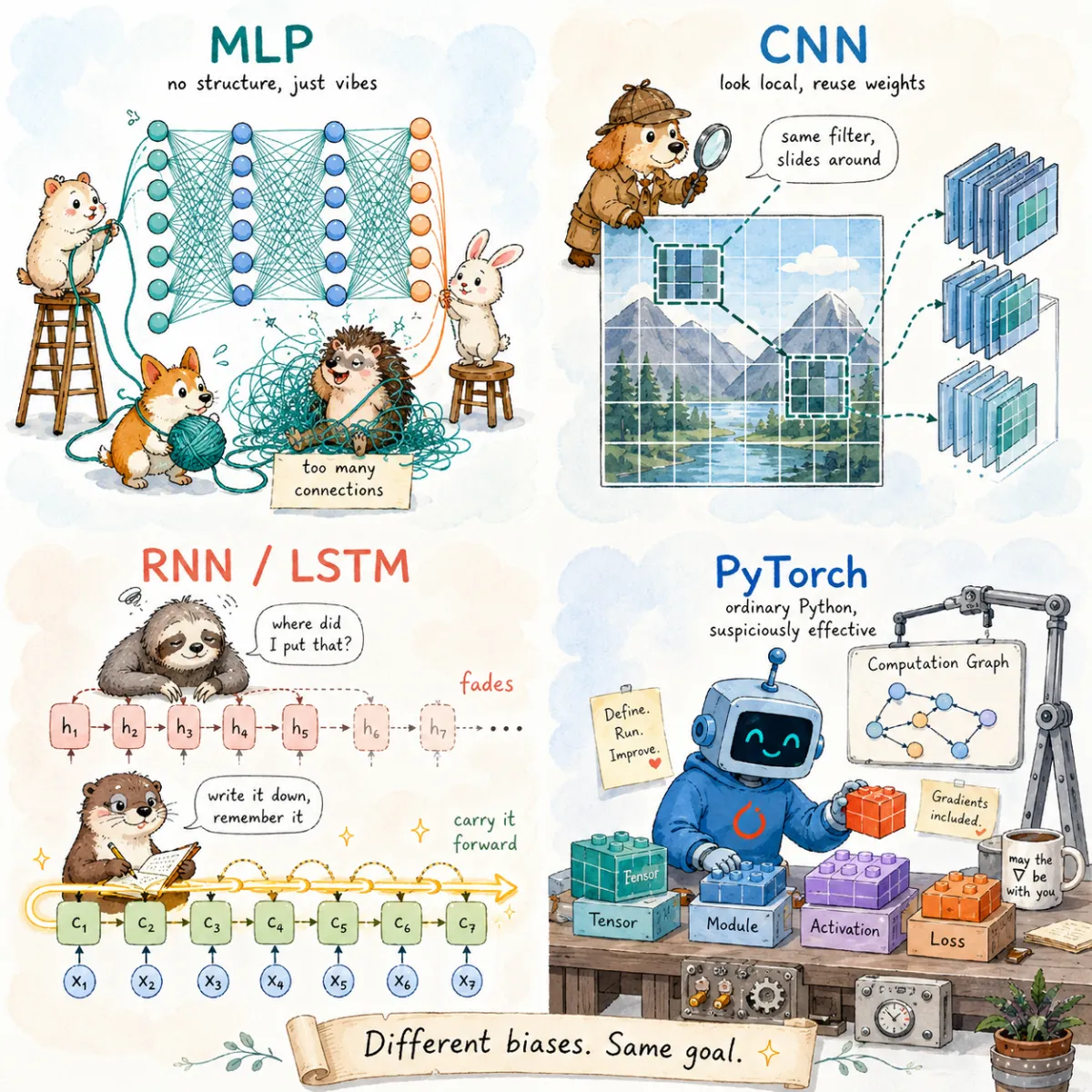
An architecture is a claim about your data, and every claim here is measured: why a stack of linear layers is one straight line, what a CNN's first layer actually learns, how fast a receptive field grows, where an RNN's gradient dies — and PyTorch as three ideas: a tensor, a tape, and a module.

  • deep-learning
  • pytorch
  • cnn
  • lstm
Read
Updated Jul 21, 2026
02
Lab inside

Mechanistic Interpretability: Looking Inside the Black Box

What it actually means to reverse-engineer a neural network into features and circuits: the residual stream as a linear object, the linear representation hypothesis, superposition and why features outnumber neurons, sparse autoencoders as dictionary learning, the QK/OV decomposition of attention, induction heads, and the causal methods — activation and path patching — that turn a plausible story into a verified mechanism.

  • interpretability
  • mechanistic-interpretability
  • superposition
  • sparse-autoencoders
  • +1
Read
Updated Jul 3, 2026
03
Lab inside

Teaching a Neural Network to Play Go

Building a tiny AlphaGo from scratch on a 5×5 board: board representation, a small CNN policy network, a value network, and then Monte Carlo Tree Search — with each piece introduced only when the previous version visibly runs out of road. Ends at a self-play loop that is recognisably AlphaZero in miniature.

  • reinforcement-learning
  • monte-carlo-tree-search
  • self-play
  • cnn
  • +2
Read
04
Lab inside

Training Neural Networks: Backprop, Regularization, and Everything in Between

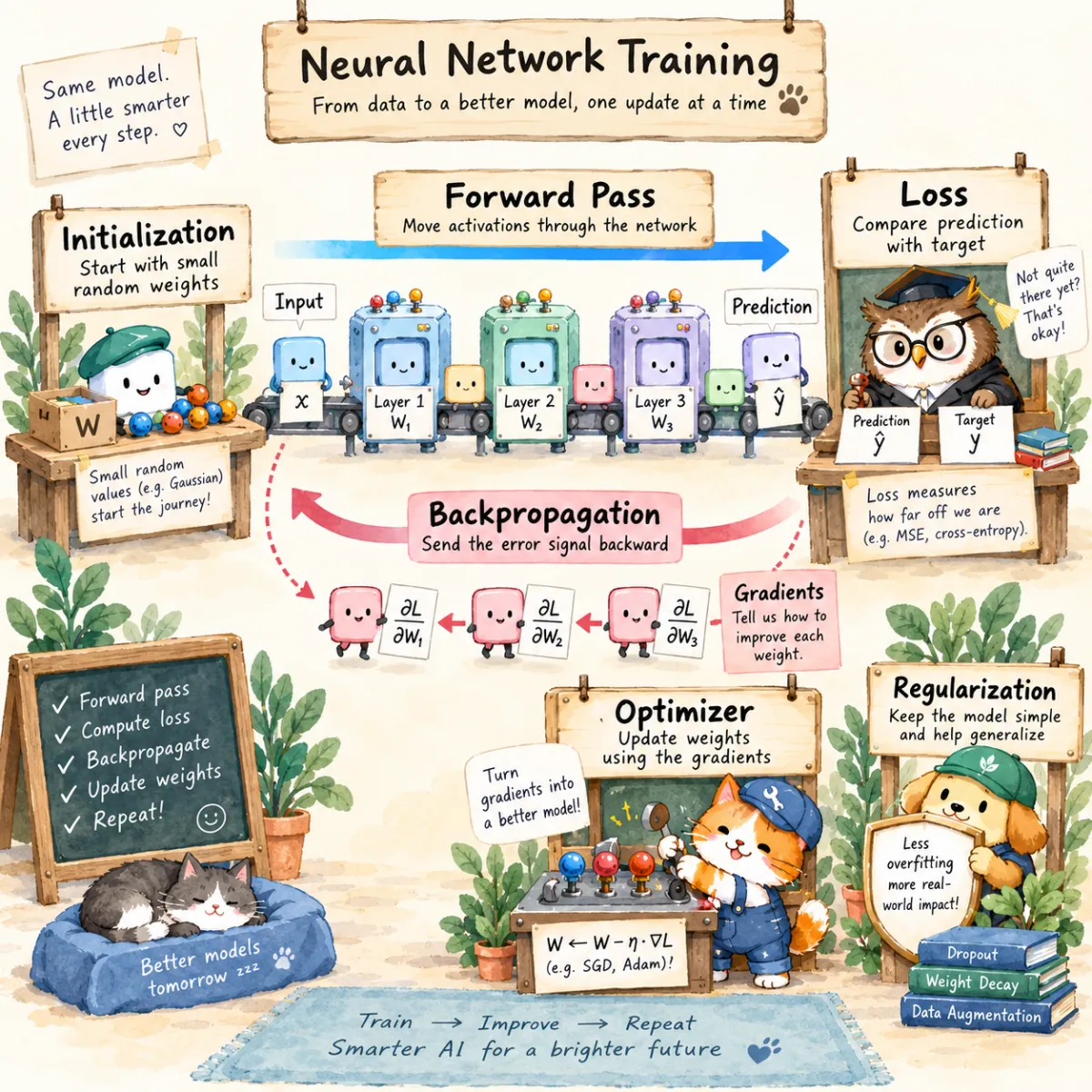
One number at the end of the network has to become an instruction for every number inside it. That trip is the whole of training: backpropagation as the chain rule run backwards through a graph, the product of many numbers that decides whether the instruction survives the journey, the initialization arithmetic that keeps that product near one and the normalization, clipping and precision choices that answer the other half of the problem, and regularization as the deliberate corruption that makes the result generalize — every claim carried by one worked example, from two weights done by hand to a network that overfits.

  • deep-learning
  • backpropagation
  • gradient-descent
  • initialization
  • +1
Read