Lab · runnable experiments
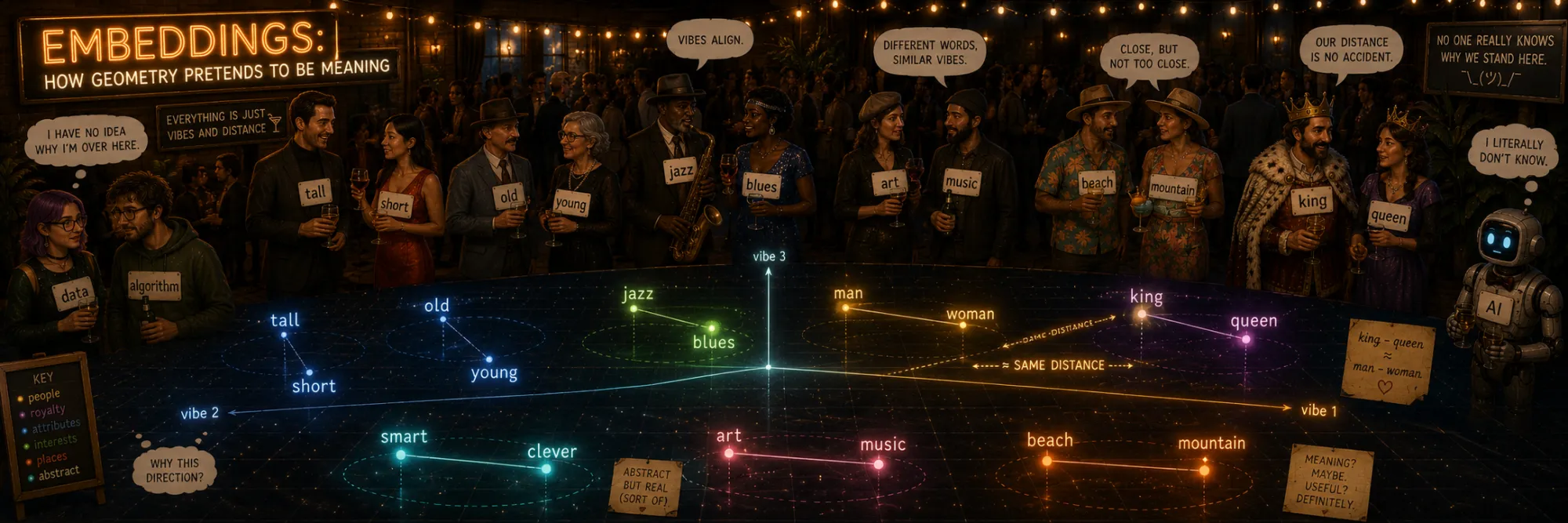
Embeddings: How Geometry Pretends to Be Meaning
Created Jun 8, 2026 Updated Jun 8, 2026
Read the parent noteThis lab re-creates, with real models, the claims the note makes about embedding geometry. It is deliberately small in workload — controlled toy corpora and short retrieval tasks — so the core cells are CPU-friendly; the first run is dominated by model downloads, which then cache. The heavy lesson the note draws is visible even at this scale.
Requirements
pip install sentence-transformers transformers torch pandas numpy scikit-learn matplotlibNumbers may vary slightly across model and library versions; the qualitative effects should remain.
Setup
import os, warnings, datetime, numpy as np, pandas as pd, torch
os.environ["TOKENIZERS_PARALLELISM"] = "false"  # silence the tokenizers fork warning
warnings.filterwarnings("ignore")
import transformers; transformers.logging.set_verbosity_error()
from sentence_transformers import SentenceTransformer

np.random.seed(0); torch.manual_seed(0)

def cos(a, b) -> float:
    a, b = np.asarray(a, float), np.asarray(b, float)
    return float(a @ b / (np.linalg.norm(a) * np.linalg.norm(b)))

mini = SentenceTransformer("sentence-transformers/all-MiniLM-L6-v2")

def emb(texts, model=mini, normalize=True):
    return model.encode(texts, normalize_embeddings=normalize, show_progress_bar=False)

print("executed:", datetime.date.today().isoformat())
print("torch", torch.__version__, "· transformers", transformers.__version__)
print("workhorse model: all-MiniLM-L6-v2 · dim =", mini.get_sentence_embedding_dimension())
executed: 2026-06-08
torch 2.12.0 · transformers 4.44.2
workhorse model: all-MiniLM-L6-v2 · dim = 384Embedding is a compression
Any text — three characters or three sentences — comes out as the same fixed-length vector. That fixed width is the bottleneck the note describes.
texts = [
    "overheating",
    "My car's engine keeps overheating on the highway after about twenty minutes "
    "of driving in heavy summer traffic, especially when the air conditioning is on.",
]
V = emb(texts)
print("short text  ->", V[0].shape)
print("long text   ->", V[1].shape, "(same width — everything is squeezed through it)")
short text -> (384,)
long text -> (384,) (same width — everything is squeezed through it)Cosine reads direction, not words
car engine overheating and vehicle temperature problem share almost no tokens, yet land close; an unrelated finance sentence stays far. Meaning is induced by training pressure, not by word overlap.
words = ["cat", "kitten", "small domestic animal",
         "car engine overheating", "vehicle temperature problem",
         "quarterly revenue forecast"]
E = emb(words)
pd.DataFrame(np.round(E @ E.T, 2), index=words, columns=[w[:13] for w in words])| cat | kitten | small domesti | car engine ov | vehicle tempe | quarterly rev | |
|---|---|---|---|---|---|---|
| cat | 1.00 | 0.79 | 0.41 | 0.08 | 0.03 | 0.08 |
| kitten | 0.79 | 1.00 | 0.40 | 0.10 | 0.04 | 0.11 |
| small domestic animal | 0.41 | 0.40 | 1.00 | -0.01 | 0.01 | -0.03 |
| car engine overheating | 0.08 | 0.10 | -0.01 | 1.00 | 0.45 | 0.03 |
| vehicle temperature problem | 0.03 | 0.04 | 0.01 | 0.45 | 1.00 | 0.04 |
| quarterly revenue forecast | 0.08 | 0.11 | -0.03 | 0.03 | 0.04 | 1.00 |
Anisotropy: why cosine on raw BERT is mostly geometry noise
The note’s central claim about why contrastive training matters: a raw, un-finetuned BERT space is anisotropic — every vector points roughly the same way, so even unrelated texts score high cosine. A contrastively-trained model spreads the space out. We measure the cosine between random, unrelated sentence pairs in both.
from transformers import AutoTokenizer, AutoModel
tok = AutoTokenizer.from_pretrained("distilbert-base-uncased")
bert = AutoModel.from_pretrained("distilbert-base-uncased").eval()

@torch.no_grad()
def bert_mean(texts):
    enc = tok(list(texts), padding=True, truncation=True, return_tensors="pt")
    h = bert(**enc).last_hidden_state
    m = enc["attention_mask"].unsqueeze(-1).float()
    return ((h * m).sum(1) / m.sum(1)).numpy()

unrelated = [
    "The recipe calls for two cups of flour and a pinch of salt.",
    "Quarterly revenue rose across all three regions last year.",
    "The hiking trail closes at dusk during the winter months.",
    "She tuned the guitar before the evening rehearsal.",
    "Photosynthesis converts sunlight into chemical energy in plants.",
    "The train to the airport leaves every fifteen minutes.",
    "He repainted the fence a pale shade of green on Sunday.",
    "The committee postponed the vote until next Thursday.",
    "Saturn's rings are made mostly of ice and rock.",
    "The cafe on the corner serves oat-milk lattes.",
    "Interest rates were left unchanged at the latest meeting.",
    "The novel is set in a coastal town in the 1950s.",
    "Add the onions and cook until translucent.",
    "The marathon route passes three city bridges.",
    "Gravity bends the path of light near massive objects.",
    "The printer is out of cyan ink again.",
    "Their flight was delayed by a thunderstorm.",
    "The museum's new wing opens to the public in spring.",
    "Bees communicate the location of flowers by dancing.",
    "He filed the tax return a day before the deadline.",
    "The orchestra rehearsed the symphony's final movement.",
    "Sea turtles return to the beach where they hatched.",
    "The software update fixed the battery-drain bug.",
    "A cold front will move through the valley overnight.",
    "The library extended its hours during exam week.",
    "The bridge was repainted to prevent corrosion.",
    "Volcanic soil is unusually fertile for growing coffee.",
    "She swapped the summer tires for winter ones.",
    "The startup raised a modest seed round in March.",
    "The choir sang two encores to a full hall.",
    "Migrating geese fly in a V to save energy.",
    "The contract was signed after weeks of negotiation.",
    "He grilled the vegetables over a low flame.",
    "The telescope captured a faint distant galaxy.",
    "The ferry crosses the strait twice a day.",
    "The class debated the ethics of the proposal.",
]

def random_pair_cos(vecs):
    vn = vecs / np.linalg.norm(vecs, axis=1, keepdims=True)
    S = vn @ vn.T
    return S[np.triu_indices(len(vecs), k=1)]

raw = random_pair_cos(bert_mean(unrelated))
trained = random_pair_cos(emb(unrelated, normalize=False))
print(f"raw distilbert (mean-pooled): mean cosine of random pairs = {raw.mean():.2f}")
print(f"all-MiniLM-L6 (contrastive) : mean cosine of random pairs = {trained.mean():.2f}")
raw distilbert (mean-pooled): mean cosine of random pairs = 0.64
all-MiniLM-L6 (contrastive) : mean cosine of random pairs = 0.07import matplotlib.pyplot as plt
plt.figure()
plt.hist(raw, bins=18, alpha=.7, color="#9a6f2f", label=f"raw distilbert (μ={raw.mean():.2f})")
plt.hist(trained, bins=18, alpha=.7, color="#2c5142", label=f"all-MiniLM (μ={trained.mean():.2f})")
plt.xlabel("cosine of random, unrelated pairs"); plt.ylabel("count"); plt.legend()
plt.tight_layout(); plt.show()
Cosine vs Euclidean on the unit sphere
When vectors are L2-normalized, ‖a − b‖² = 2 − 2·cos(a, b) exactly — so ranking by one equals ranking by the other. The “which metric?” debate evaporates.
a, b = emb(["how do I reset my password?", "steps to recover a forgotten login"])
c = cos(a, b)
print(f"cosine            = {c:.4f}")
print(f"‖a-b‖²            = {np.sum((a-b)**2):.4f}")
print(f"2 - 2·cos         = {2 - 2*c:.4f}   (identical)")

# ranking equivalence over a small candidate set
q = emb(["how do I reset my password?"])[0]
cands = emb(["reset your account password", "the cat sat on the mat",
             "recover a forgotten login", "quarterly revenue forecast"])
by_cos = np.argsort(-(cands @ q))
by_euc = np.argsort(np.sum((cands - q)**2, axis=1))
print("rank by cosine  :", by_cos.tolist())
print("rank by euclid  :", by_euc.tolist(), "  -> same order:", (by_cos == by_euc).all())
cosine = 0.5904
‖a-b‖² = 0.8193
2 - 2·cos = 0.8193 (identical)
rank by cosine : [0, 2, 1, 3]
rank by euclid : [0, 2, 1, 3] -> same order: TrueSame topic, opposite facts
The embedding keeps the topic and underweights the tiny token that flips the answer. Opposite statements sit at near-duplicate cosine.
pairs = [
    ("the treatment is safe for patients",      "the treatment is not safe for patients", "negation"),
    ("John sued Mary",                          "Mary sued John",                          "entity roles"),
    ("revenue grew 5% this quarter",            "revenue grew 50% this quarter",           "quantity"),
    ("the outage may happen tomorrow",          "the outage did happen yesterday",         "tense / modality"),
]
rows = [(k, round(cos(*emb([a, b])), 3)) for a, b, k in pairs]
pd.DataFrame(rows, columns=["distinction the model should make", "cosine(A, B)"])| distinction the model should make | cosine(A, B) | |
|---|---|---|
| 0 | negation | 0.900 |
| 1 | entity roles | 0.993 |
| 2 | quantity | 0.851 |
| 3 | tense / modality | 0.801 |
And the production-dangerous version — against a “is it safe?” query, the negated chunk is still pulled in close; the not barely dents the score:
q = emb(["is this treatment safe for patients?"])[0]
print(f"cos(query, '...is safe...')     = {cos(q, emb(['the treatment is safe for patients'])[0]):.3f}")
print(f"cos(query, '...is NOT safe...') = {cos(q, emb(['the treatment is not safe for patients'])[0]):.3f}")
print("Both land high — the opposite statement is only a hair behind, easily close enough to outrank real evidence.")
cos(query, '...is safe...') = 0.933
cos(query, '...is NOT safe...') = 0.838
Both land high — the opposite statement is only a hair behind, easily close enough to outrank real evidence.Query / passage prefixes: the bug a toy eval doesn’t catch
Here is the trap the note warns about, reproduced honestly. We run a tiny labeled retrieval (queries + their correct passages + hard near-miss distractors) and score it under correct prefixes, no prefix, and swapped prefixes. The expectation is that the wrong prefix hurts — and on a small, clean set, it doesn’t visibly:
e5 = SentenceTransformer("intfloat/e5-base-v2")
queries = ["how do I reset my password?", "what is the refund window?", "how long does shipping take?",
           "how do I update my billing card?", "is my customer data encrypted?"]
passages = [
    "To reset your password, open Settings, choose Security, and follow the reset link emailed to you.",
    "Our refund policy allows returns within thirty days of the original purchase date for a full refund.",
    "Standard shipping is delivered within five to seven business days after the order is dispatched.",
    "Update the credit card on file under Billing, then Payment methods, then Edit card.",
    "All customer data is encrypted at rest with AES-256 and in transit over TLS 1.3.",
    # hard near-misses: same surface, wrong intent
    "To change your account email, open Settings, choose Profile, and follow the verification link emailed to you.",
    "Our privacy policy explains how account data is retained for thirty days before permanent deletion.",
    "Express shipping is delivered within one to two business days for an additional fee at checkout.",
    "Update the mailing address on file under Profile, then Addresses, then Edit address.",
    "All account passwords are hashed with bcrypt before they are written to the database.",
]
def mrr(model, qpre, dpre):
    Q = model.encode([qpre + q for q in queries], normalize_embeddings=True, show_progress_bar=False)
    D = model.encode([dpre + p for p in passages], normalize_embeddings=True, show_progress_bar=False)
    S = Q @ D.T
    return float(np.mean([1.0 / (1 + int(np.sum(S[i] > S[i, i]))) for i in range(len(queries))]))

print("mean reciprocal rank of the correct passage (1.0 = always ranked first):")
print(f"  E5  · correct prefixes (query:/passage:) = {mrr(e5, 'query: ', 'passage: '):.3f}")
print(f"  E5  · no prefix                          = {mrr(e5, '', ''):.3f}")
print(f"  E5  · swapped (passage:/query:)          = {mrr(e5, 'passage: ', 'query: '):.3f}")
print(f"  all-MiniLM · no prefix (its correct mode)= {mrr(mini, '', ''):.3f}")
mean reciprocal rank of the correct passage (1.0 = always ranked first):
E5 · correct prefixes (query:/passage:) = 1.000
E5 · no prefix = 1.000
E5 · swapped (passage:/query:) = 1.000
all-MiniLM · no prefix (its correct mode)= 1.000All four read 1.0 — and that is the finding. On a small, clean set the wrong prefix changes nothing you can see. In real retrieval benchmarks, prefix mistakes can show up as measurable nDCG loss — but this toy set is too small to expose it. That is exactly why a missing or swapped prefix is a silent production bug: the smoke test passes, retrieval “still finds something,” and the regression hides until a real evaluation — or a user — surfaces it weeks later. (To prove a model hears the prefix at all, the note’s own tip is a model-card check plus an A/B on a real eval set, not a toy cosine.)
Pooling decides which space you land in
CLS-pooling and mean-pooling of the same raw model give different vectors — different geometry. You can’t mix them downstream.
@torch.no_grad()
def bert_pool(texts, how):
    enc = tok(list(texts), padding=True, truncation=True, return_tensors="pt")
    h = bert(**enc).last_hidden_state
    if how == "cls":
        return h[:, 0].numpy()
    m = enc["attention_mask"].unsqueeze(-1).float()
    return ((h * m).sum(1) / m.sum(1)).numpy()

t = ["how do I reset my password", "steps to recover a forgotten login", "the cat sat on the mat"]
cls, mean = bert_pool(t, "cls"), bert_pool(t, "mean")
print(f"CLS  : cos(reset, recover)={cos(cls[0],cls[1]):.3f}   cos(reset, cat)={cos(cls[0],cls[2]):.3f}")
print(f"mean : cos(reset, recover)={cos(mean[0],mean[1]):.3f}   cos(reset, cat)={cos(mean[0],mean[2]):.3f}")
CLS : cos(reset, recover)=0.952 cos(reset, cat)=0.950
mean : cos(reset, recover)=0.814 cos(reset, cat)=0.637Dimension is the width of the bottleneck
Naively chopping a 1024-dim vector to its first k coordinates is unreliable for a model that wasn’t trained for it: the ranking margin doesn’t decay gracefully, it just wobbles, because the leading coordinates were never trained to be a standalone embedding — and the retrieval order drifts with it: rank correlation against the full-1024 ranking slips from a perfect 1.0 toward ~0.7 as coordinates are chopped, so results quietly reshuffle. Storage, by contrast, scales exactly linearly with dimension — that part is clean. The wobble is precisely the problem Matryoshka representation learning fixes: it trains the first k coordinates to already be a usable embedding, turning dimension into a safe runtime knob.
big = SentenceTransformer("intfloat/multilingual-e5-large")  # 1024-dim
docs = ["passage: " + d for d in [
    "To reset your password, open Settings and choose Security, then Reset.",
    "Change your account password from the Security tab after email verification.",
    "Our refund policy allows returns within thirty days of purchase.",
    "Refunds are issued to the original payment method within five business days.",
    "The vacation policy grants twenty paid days off per calendar year.",
    "Unused vacation days roll over up to a maximum of five days.",
    "Contact support if your account is locked after failed logins.",
    "Accounts lock automatically after five failed login attempts.",
    "Invoices are issued on the first business day of each month.",
    "Download past invoices from the Billing page under Invoice history.",
    "Two-factor authentication can be enabled in the Security settings.",
    "Standard shipping is delivered within five to seven business days.",
    "Express shipping arrives in one to two business days for a fee.",
    "Update the credit card on file under Billing, then Payment methods.",
    "All customer data is encrypted at rest with AES-256 and in transit over TLS.",
    "Export your account data as a CSV from the Privacy settings.",
    "Team members can be invited from the Members page by an admin.",
    "Notification preferences are managed under Account, then Notifications.",
    "The API rate limit is one thousand requests per minute per key.",
    "Webhooks can be configured in the Integrations panel.",
    "Cancel your subscription anytime from the Billing page before renewal.",
    "Upgrading your plan takes effect immediately and is prorated.",
    "Set your time zone under Account preferences to fix timestamp display.",
    "The mobile app supports offline mode for previously loaded content.",
    "Single sign-on is available on the enterprise plan via SAML.",
]]
D = big.encode(docs, normalize_embeddings=True, show_progress_bar=False)
qv = big.encode(["query: how do I change my account password?"],
                normalize_embeddings=True, show_progress_bar=False)[0]

def renorm(M, dim):
    Mt = M[..., :dim]
    return Mt / np.linalg.norm(Mt, axis=-1, keepdims=True)

def ranks(x):                        # dense ranks (argsort of argsort) — no scipy needed
    return np.argsort(np.argsort(x))

full = renorm(D, 1024) @ renorm(qv, 1024)   # full-dimensional ranking — the reference order

rows = []
for dim in [1024, 512, 256, 128, 64, 32, 16]:
    sims = renorm(D, dim) @ renorm(qv, dim)
    top = np.sort(sims)[::-1]
    rank_corr = float(np.corrcoef(ranks(sims), ranks(full))[0, 1])  # retrieval order vs full-1024
    rows.append([dim, round(float(top[0] - top[1]), 3), round(rank_corr, 2),
                 f"{4*dim/1024:.1f} KB", f"{4*dim*1_000_000/1e9:.1f} GB"])
pd.DataFrame(rows, columns=["dim", "top1–top2 margin", "order vs full-1024 (rank corr)",
"per vector", "per 1M vectors"])| dim | top1–top2 margin | order vs full-1024 (rank corr) | per vector | per 1M vectors | |
|---|---|---|---|---|---|
| 0 | 1024 | 0.010 | 1.00 | 4.0 KB | 4.1 GB |
| 1 | 512 | 0.005 | 0.97 | 2.0 KB | 2.0 GB |
| 2 | 256 | 0.007 | 0.90 | 1.0 KB | 1.0 GB |
| 3 | 128 | 0.021 | 0.84 | 0.5 KB | 0.5 GB |
| 4 | 64 | 0.011 | 0.71 | 0.2 KB | 0.3 GB |
| 5 | 32 | 0.027 | 0.73 | 0.1 KB | 0.1 GB |
| 6 | 16 | 0.005 | 0.75 | 0.1 KB | 0.1 GB |
Hubness: a few points are everyone’s neighbor
In high dimensions some points get pulled into a disproportionate share of other points’ nearest-neighbor lists — the note’s “heavy head.” We build a ~1,500-line single-domain corpus (a product help center: many specific, similar articles) plus a handful of generic filler lines, and count how often each lands in another’s top-10. If the space were even, every line would appear about k = 10 times.
rng = np.random.default_rng(0)

# A single-domain knowledge base: many specific, *similar* help-center lines.
acts   = ["reset", "update", "change", "verify", "cancel", "renew", "export", "enable",
          "disable", "upgrade", "transfer", "delete", "restore", "configure", "schedule"]
objs   = ["password", "billing card", "email address", "subscription plan", "API key",
          "two-factor login", "notification settings", "account data", "shipping address",
          "team seats", "invoice history", "display name", "payment method", "time zone", "webhook"]
places = ["Settings", "the Billing page", "your Profile", "the Security tab",
          "the Admin console", "Account preferences", "the Integrations panel"]
tails  = ["after you confirm by email.", "once the change is verified.",
          "and it takes effect immediately.", "before the next billing cycle.",
          "and a confirmation is sent to you."]
combos = [(a, o, p, t) for a in acts for o in objs for p in places for t in tails]
rng.shuffle(combos)
kb = [f"To {a} your {o}, open {p} and save {t}" for a, o, p, t in combos[:1500]]

# Generic filler: same domain words, no specific content.
filler = ["For more information, please contact our support team.",
          "Please refer to the documentation for further details.",
          "Was this article helpful? Let us know your feedback.",
          "Thank you for using our product and services.",
          "See the related articles below for more assistance.",
          "These settings can be managed from your account at any time."]
corpus = kb + filler
n_kb = len(kb)

C = emb(corpus, normalize=True)                       # all-MiniLM, the workhorse
S = C @ C.T; np.fill_diagonal(S, -1.0)
k = 10
indeg = np.bincount(np.argpartition(-S, k, axis=1)[:, :k].ravel(), minlength=len(corpus))
med = float(np.median(indeg[:n_kb]))

print(f"corpus = {len(corpus)} lines ({n_kb} help articles + {len(filler)} generic filler) · fair share k = {k}")
print(f"help-article in-degree:  median {med:.0f} · mean {indeg[:n_kb].mean():.1f} · "
      f"p99 {np.percentile(indeg[:n_kb], 99):.0f} · max {indeg[:n_kb].max()}   <- heavy head = hubness\n")
print("heaviest hubs — the densest near-duplicate articles, neighbor to many:")
for i in np.argsort(-indeg)[:4]:
    print(f"  {indeg[i]:3}×   {corpus[i][:56]}")
print("\ngeneric filler — far BELOW the median: an anti-hub. It shares the words, not the geometry:")
for i in range(n_kb, len(corpus)):
    print(f"  {indeg[i]:3}×   {corpus[i][:56]}")
corpus = 1506 lines (1500 help articles + 6 generic filler) · fair share k = 10
help-article in-degree: median 10 · mean 10.0 · p99 22 · max 28 <- heavy head = hubness
heaviest hubs — the densest near-duplicate articles, neighbor to many:
28× To update your invoice history, open Settings and save o
26× To update your email address, open Settings and save aft
24× To change your API key, open the Admin console and save
23× To change your notification settings, open the Admin con
generic filler — far BELOW the median: an anti-hub. It shares the words, not the geometry:
3× For more information, please contact our support team.
1× Please refer to the documentation for further details.
2× Was this article helpful? Let us know your feedback.
1× Thank you for using our product and services.
3× See the related articles below for more assistance.
1× These settings can be managed from your account at any tplt.figure()
plt.hist(indeg[:n_kb], bins=range(0, int(indeg[:n_kb].max()) + 2), color="#4a6b8a", alpha=.85, label="help articles")
plt.axvline(k, color="#9a6f2f", linestyle="--", label=f"fair share (k={k})")
plt.axvline(indeg[n_kb:].max(), color="#c4521e", linestyle=":", label=f"heaviest filler ({indeg[n_kb:].max()}×)")
plt.xlabel(f"times a line appears in others' top-{k}"); plt.ylabel("number of lines"); plt.legend()
plt.tight_layout(); plt.show()
So the heavy top-k head is real — that part of the note reproduces directly. But the hubs here are the densest lines (many near-identical neighbors), not the generic filler: in a spread-out contrastive space, generic text is isolated, not central. “Hubness” (a geometry effect) and “boilerplate bloat” (a content effect) can both surface as a heavy head, yet they’re different problems — worth separating when you diagnose which one you have.
Dense is uncertain about exact identifiers; sparse is decisive
The tell is a near-miss: two error codes of the same shape but different digits. Dense ranks the right one first — but only by a thin margin, because to it the two codes look nearly alike. Sparse is decisive: the wrong code scores exactly zero, since the exact string isn’t in it. That difference in decisiveness on identifiers is why production goes hybrid.
from sklearn.feature_extraction.text import TfidfVectorizer
corpus2 = [
    "To resolve ERR_TIMEOUT_4012, raise the gateway read timeout in the proxy config.",   # correct
    "To resolve ERR_TIMEOUT_4093, restart the upstream authentication service.",          # same shape, wrong code
    "High network latency causes request timeouts when the upstream service is slow.",
    "Restart the service and verify the firewall rules for any blocked ports.",
]
query = "ERR_TIMEOUT_4012"

dsims = emb(corpus2) @ emb([query])[0]
vec = TfidfVectorizer().fit(corpus2 + [query])
ssims = (vec.transform(corpus2) @ vec.transform([query]).T).toarray().ravel()

print(f"query: {query}   (correct = #0; #1 is a different code of the same shape)\n")
print(f"dense  (MiniLM)  #0 {dsims[0]:.3f} vs #1 {dsims[1]:.3f}   gap {abs(dsims[0]-dsims[1]):.3f}  <- can it tell the codes apart?")
print(f"sparse (TF-IDF)  #0 {ssims[0]:.3f} vs #1 {ssims[1]:.3f}   gap {abs(ssims[0]-ssims[1]):.3f}")
print(f"\ndense top-1 = #{int(np.argmax(dsims))} · sparse top-1 = #{int(np.argmax(ssims))} (sparse locks onto the exact string)")
query: ERR_TIMEOUT_4012 (correct = #0; #1 is a different code of the same shape)
dense (MiniLM) #0 0.764 vs #1 0.663 gap 0.102 <- can it tell the codes apart?
sparse (TF-IDF) #0 0.252 vs #1 0.000 gap 0.252
dense top-1 = #0 · sparse top-1 = #0 (sparse locks onto the exact string)Chunking changes the object you embed
Split the rule and the small “answer” chunk still retrieves with high cosine — but the condition that gates it has been cut away into a different chunk. The note’s insurance trap, reproduced.
big_chunk = ("Vision correction is covered under the plan. "
             "This benefit applies only after 12 months of continuous coverage.")
small_a = "Vision correction is covered under the plan."
small_b = "This benefit applies only after 12 months of continuous coverage."
qv = emb(["is vision correction covered?"])[0]

for name, txt in [("large chunk (answer + condition)", big_chunk),
                  ("small chunk A (answer only)",      small_a),
                  ("small chunk B (condition only)",   small_b)]:
    print(f"  cos = {cos(qv, emb([txt])[0]):.3f}   {name}")
print("\nThe small answer-only chunk retrieves confidently — and silently drops the 12-month condition.")
cos = 0.758 large chunk (answer + condition)
cos = 0.855 small chunk A (answer only)
cos = 0.277 small chunk B (condition only)
The small answer-only chunk retrieves confidently — and silently drops the 12-month condition.What the lab shows
Every distortion the note argues for is visible on a laptop CPU once the models are cached: the anisotropic raw space, the negation/role/quantity blind spots, prefix bugs that toy evals can miss, the truncation/storage trade-off, hub points, and the dense/sparse split. The geometry is real, useful, and lies in exactly the places we can predict.